▶ 5 Moral letters to Lucilius/Letter 76 - Wikisource, the free online library en.wikisource.org
The word "honourable" is also translated as "moral worth" in footnote.
Seems to be saying a "virtuous man" is one that is has developed/cultivated their reason in accordance to nature's will. Don't think the stoics had a "free will" in the modern sense, so maybe "nature's will" is really capturing their deterministic world view?
Seems to be saying that a "good man" is definitionally one that has developed their reason to adapt to natures will (seems heavily Aristotelian).
Seems to be saying that any entity is judged based on whatever quality/attribute is unique to it. Earlier, used the example of a "good sword" as one that cuts well & pierces armor even if it's not adorned in gold. So "looking pretty" isn't a quality unique to a sword.
Something strikes me as way off about this. Not sure exactly what, but think it's related to the underlying premise that each entity has a quality unique to it.
- Like, sure, a "good sword" might be one that cuts well & pierces armor, but so does a "good spear" or a "good melee weapon".
- Also, there's the issue of repurposing things based on changing intentions. Like, I might judge a pen on it's quality to write smoothly (when I'm in a situation where writing is the intention), but say all of a sudden someone attacks me. Then I'd view the object in my hand not as "a pen", but as "a weapon/tool for defense" and it's standards I judge it on would change. iirc, this is "viewing the world instrumentally" is part of William Jamesian style of pragmatism
My prior impression was wrong. He's not looking for "Which quality ( q) is the greatest in humans?", he's looking for "Which quality ( q) is unique in humans?" which he seems to believe is reason.
I'm having a hard time understanding what Seneca's saying here. Some first passes:
- "In each thing ..."
- Probably referring to examples like his vine, stag, & dog ones mentioned earlier.
- "... that quality ..."
- Which quality? The qualities for judging the dog vary depending on the intended use/goal (tracking prey, catching prey, attacking/herding it). So maybe one could think of the idea of "setting standards" as a function (s: \text{Goal} \to \text{Qualities}).
- The issue that comes up here is that the function (s) probably also needs a second input for the actual "thing" being judged (the vine, stag, dog). In other words, (s(g)=q) wouldn't make sense since it'd be saying something like, "the standard of goal ( g), is quality ( q)" like "the standard of goal 'find trail of wild beast' is quality 'keenness of scent'".
- Instead, one might use ( s(x,g)=q) which would say something like, "the standard for entity ( x) with goal ( g) is quality ( q)."
- A concrete example to illustrate why this is necessary is letting ( x = \text{"a human being"}) and ( g = \text{"tracking prey"}), then it's unlikely that the quality by which to judge a human being's ability to track prey would be ( q = \text{keenness of scent}). Instead, the quality by which to judge them might be visual prowess, ability to anticipate prey's migration patterns, keenness of hearing, etc.
- This example is making me realize that there's likely a rank-ordering of importance in the qualities being used to for a standard of comparison. Like maybe, ( s(\text{human being}, \text{tracking prey})= (q1, q2, … , qn)) where ( q1) is the 1st most important quality (maybe "anticipate migration patterns")
- In other words, maybe ( s) isn't actually a real-valued function (ie, takes you to just one output) but a vector-valued function
- This example is making me realize that there's likely a rank-ordering of importance in the qualities being used to for a standard of comparison. Like maybe, ( s(\text{human being}, \text{tracking prey})= (q1, q2, … , qn)) where ( q1) is the 1st most important quality (maybe "anticipate migration patterns")
- The issue that comes up here is that the function (s) probably also needs a second input for the actual "thing" being judged (the vine, stag, dog). In other words, (s(g)=q) wouldn't make sense since it'd be saying something like, "the standard of goal ( g), is quality ( q)" like "the standard of goal 'find trail of wild beast' is quality 'keenness of scent'".
- Which quality? The qualities for judging the dog vary depending on the intended use/goal (tracking prey, catching prey, attacking/herding it). So maybe one could think of the idea of "setting standards" as a function (s: \text{Goal} \to \text{Qualities}).
- "... should be best for which the thing is brought into being and by which it is judged."
- "for which the thing is brought into being"
- Telos? The end goal?
- No, maybe he's saying "Look at the quality ( q) that is best in entity (x). That will tell you the reason ( x) was brought into existence which also tells you what standard to judge ( x) by."
- "for which the thing is brought into being"
▶ 1 Spectrogram spectrogram.sciencemusic.org
Great tool mention in the video "NMC Learning at Home: Spectrograms & Your Voice". Found it while looking for objective measurements to distinguish falsetto and head voice.
▶ 11 Vaccines and Autism: A Tale of Shifting Hypotheses academic.oup.com
If vaccines had some impact, then there should have been higher rates of vaccines among children with autism
In other words, there was a positive trend over time, but nothing happened to the rate of change (slope) of the trend after an introduction of MMR vaccines. If they had any effort, we would've expected the slope to increase
Helps with causal inference since there are some countries with before and after MMR vaccines
Controls for different countries and seasonal effects
High statistical power implies that they'd be able to detect even small changes. Need to see what the statistical power was
No specific peptides have been identified as traveling from gut to brain.
No evidence that certain viruses are more common in children with or without autism
It's at least possible that there are several etiologies for ASD, so maybe there are some predispositions that would be susceptible to this specific mech of action?
Confirmation bias and selection bias
Give the large volume of kids, there's bound to be some that had autism and the vaccine by pure chance
Lancet study lacked controls
▶ 1 Sing Without Straining: 10 Exercises to Eliminate Tension and Free Your Voice www.youtube.com
Some handy tips someone has on how they increased their head voice range as a baritone.
▶ 1 Your Evening Routine Is Broken www.additudemag.com
An very brief article from [[ADDitude Magazine]] with some helpful bulleted lists of things covering the following
- Devise a Smart Bedtime Routine
- Morning Routine at Home
- Morning Routine at Work
- How to Build a Routine
Some of these tips deserve to be made into [[Anki]] cards later.
▶ 2 Mindfulness Prescription for Adult ADHD - Exercises soundcloud.com
A very useful [[meditation]] by [[Lidia Zylowska]] that asks the listener to focus on their thoughts. Seems similar to [[Mahamudra chopping]] (a la [[Loch Kelly]]). Possibly needs to be adapted for those with [[aphantasia]] or [[people who don't have inner speech]].
A meditation course by [[Lidia Zylowska]] mentioned during the [[ADDA Mindfulness Meditation]] session [[2023-08-05 VPSG; Mindfulness Meditation for the ADHD Brain]]. Purported to be developed to specifically target [[ADHD]].
▶ 1 A viral article has split us into two different ways of thinking. This is the science behind it www.abc.net.au
A brief article that gives some speculations on why there are some [[people who don't have inner speech]].
▶ 1 Difference Between Journal and Ledger (with Comparison Chart) - Key Differences keydifferences.com
A good article distinguishing between an [accounting journal]] and an [[accounting ledger]] as it applies to the domain of [[finance]]. I learned about this while reading the [wiki article on [[distributed ledger technology]]. It was cited as a source for the passage
In some cases, where the distributed digital information functions as an accounting journal rather than an accounting ledger, another term is used: RJT for replicated journal technology.[5]
▶ 1 Top 6 YouTube Channels On Cybersecurity To Follow This Year - Scam Detector www.scam-detector.com
Some [[YouTube]] channel recommendations for [[cybersecurity]], both for professionals and regular users.
▶ 1 Coursera’s journey to GraphQL www.apollographql.com
A good article on how [[Coursera]] moved from [[REST]] [[API]]s to a [[GraphQL]] API an the troubles they encountered along the way.
▶ 1 How Microsoft is using GraphQL in their new Teams architecture bartwullems.blogspot.com
Explains how the [[GraphQL]] [[API]] is being used in [[Microsoft Teams]].
▶ 1 VVIQ Results · Aphantasia Network aphantasia.com
An interesting website that offers a VVIQ test for people's capacity to visualize things in "the mind's eye". May be helpful for people who have [[aphantasia]].
▶ 1 People With No Internal Monologue Explain What It's Like In Their Head www.iflscience.com
After learning about [[aphantasia]] (people who can't visualize things in their mind's eye), I wanted to know more about people without an inner monologue.
▶ 1 Commons Engine – Designing Commons-Oriented Economies commonsengine.org
Camacho said that Commons Engine put together (along with [[MetaCurrency]]) workshops on how to design currencies & focus on how to design [[mutual credit currencies]].
Camacho spoke highly of them.
▶ 3 Karl Popper plato.stanford.edu
Seems similar to a notion in [[neoplatonism]] that the "forms" (eidos) emanate down.
Also seems related to [[John Vervaeke]]'s notion of there being a multi-level ontology (which he claims is in neoplatonism).
In other word, "reification" or treating abstractions as if they were concrete real events or physical entities.
A theoretical construct in neuroscience/neuropsychology that is
a unit of cognitive information imprinted in a physical substance, theorized to be the means by which memories are stored1] as biophysical or biochemical[2] changes in the brain or other biological tissue, in response to external stimuli. ([wiki)
Cf. this note to a 2015 neuroscience paper that purports that it's been "found/discovered".
▶ 1 Should scientific papers inform or persuade? - PLOS Biologue biologue.plos.org
[[Octopus.ac]] is a potential alternative to [[ResearchEquals]] for open publishing founded by [[Alexandra Freeman]]. Appears to be attempting to avoid the tension for academic journals to be both "informative" and "persuasive". Seems to fall within the general [[open science]] movement.
▶ 1 Open Science and Modular Publishing crdpala.org
Compares the difference between [[Octopus.ac]] and [[ResearchEquals]] platforms in the [[open science]] movement. Looks like Octopus is more strictly matching the [[eight stages of scientific research]], whereas RE allows for more options (including "publication of text, data, code and media.") Notably, each platform gives a [[DOI]] to each publication.
Questions:
Does each module in RE get it's own DOI?
Likewise, does each publication type in Octopus get it's own DOI?
Do either of these address the concern of other academics "scooping" each other's work?
▶ 1 Octopus www.octopus.ac
[Octopus.ac]] is a potential alternative to [[ResearchEquals]], but notably doesn't mention RE anywhere on it's site (whereas RE does mention Octopus.ac in it's [FAQs). Specifically, it's comparison is here.
Each of their platforms seem to be related to the [[open science]] movement.
▶ 1 Is there an advantage of branching in version-controlled paper writing? academia.stackexchange.com
A helpful tip on how to use [[branches]] via [[Git]] or another [[version control system]] when writing academic papers.
It was made by [[D.W.]] on the [[Academia]] [[StackExchange]] site. It's in regards to working with authors who don't use Git, etc.
The idea is to make a separate branch for the version you send a specific co-author which seems like a good idea.
▶ 1 Why use version control systems for writing a paper? academia.stackexchange.com
Some links to resources on using [[LaTeX]] and [[Git]] suggested by [[Piotr Migdal]].
This was part of his top-voted answer to "Why use [[version control system]]s for writing a paper?" on the [[Academia]] [[StackExchange]] site.
Was looking into the tools available for [[open science]] collaborations.
▶ 1 What's the current state of play of efforts to reform academic publishing to more open source like inclusion of non-significant results? academia.stackexchange.com
A response by [[Allure]] to an [[Academia]] [[StackExchange]] question about alternative publishing models for scientific experiments that help deal with the [[replication crisis]].
In the comments, Allure suggests that journals that "Do results-blind peer review (reviewers receive a manuscript where the results & conclusions are omitted)" encourage publishing "non-significant results".
▶ 1 How to protect scientific open research from being patented? academia.stackexchange.com
A helpful question on [[Academia]] [[StackExchange]] about preventing [[open science]] research from being patented.
The top answer from [Gilles 'SO- stop being evil']] suggests simply publishing one's research protects it (since the disclosure counts as [prior art.
So even if an someone invents something, you publishing it stops someone from being able to file a patent on it (except in countries that have a grace period for inventors, like the US).
The only risk remaining is that you (or fellow inventor you worked with) take advantage of the grace period in countries that have this.
Some research institutions (public or private) have a formal practice of defensive publications: publish potential inventions that they don't intent to patent as soon as possible, in order to block anyone else from patenting them. Technically, any publication is a public disclosure, including an arXiv preprint, a blog post, or even a research seminar if it's legally open to external visitors. However, since it's easier to fight a patent before it's granted, it is advantageous to make it easy for patent examiners to find the defensive publication.
If you're concerned about someone filing a patent on something you discovered, or for that matter anything that you know about, you can watch patent applications. Patent applications are published for a period of at least a few months, during which time anyone can point the patent examiner to something that they consider to be prior art. Stack Exchange participates in this process through their Patents site where people can coordinate prior art searches.
▶ 1 R= FAQ www.researchequals.com
What [[ResearchEquals]] claims is different between it's platform and that of [[Octopus.ac]].
▶ 1 For funders - readme.shuttleworthfoundation.org readme.shuttleworthfoundation.org
Learned about this because
[[ResearchEquals]] is a Liberate Science GmbH project, which is funded by the [[Shuttleworth Foundation]] until the end of 2022.
▶ 1 Statistical rethinking [book review] xianblog.wordpress.com
In [[Richard McElreath]]'s [[Statistical Rethinking]], he defines [[weakly informative priors]] (aka [[regularizing priors]]) as
priors that gently nudge the machine [which] usually improve inference. Such priors are sometimes called regularizing or weakly informative priors. They are so useful that non-Bayesian statistical procedures have adopted a mathematically equivalent approach, [[penalized likelihood]]. (p. 35, 1st ed.)
▶ 1 Finding the engram ir.lib.uwo.ca
A 2015 neuroscience paper that gives 4 criteria for what an [[engram]] is, and argues that recent (at the time) developments in certain laboratory mice experiments suggested that engrams do exist.
▶ 7 https://civil.colorado.edu/~balajir/CVEN6833/bayes-resources/RM-StatRethink-Bayes.pdf civil.colorado.edu
Seems consistent with how Popper used the terms [falsification]] and [[falsifiability]] noted [here
A companion book to [Richard McElreath]]'s phenomenal lecture course [[Statistical Rethinking]] which he made freely available [here.
Note that this is the 1st ed. of the book (2015).
Note to self: don't do this.
p. 35 where [[Richard McElreath]] defines [[weakly informative priors]] aka [[regularizing priors]] in [[Bayesian statistics]]. Notes that non-Bayesian methods have a mathematically equivalent approach called [[penalized likelihood]].
McElreath is referring to (\text{P}_{0\text{B}}) (process model zero-B).
The population size & structure being "constant" is what [[Richard McElreath]] means by "equilibrium" in (\text{P}_{0\text{A}}) (process model zero-A), which corresponds to the null hypothesis
(\text{H}_0: \text{``Evolution is neutral"})
Per Andrew Gelman's wiki:
Andrew Eric Gelman (born February 11, 1965) is an American statistician and professor of statistics and political science at Columbia University.
Gelman received bachelor of science degrees in mathematics and in physics from MIT, where he was a National Merit Scholar, in 1986. He then received a master of science in 1987 and a doctor of philosophy in 1990, both in statistics from Harvard University, under the supervision of Donald Rubin.[1][2][3]
▶ 1 Falsifiability - Wikipedia en.wikipedia.org
A passage from [[Karl Popper]] about how he distinguishes between [[falsifiability]] and [[falsification]].
Popper's "falsification" seems related to [[Imre Lakatos]]'s notion that a [[research programme]] has a [[hard core]]
of central theses that are deemed irrefutable—or, at least, refutation-resistant—by methodological fiat. (Musgrave & Pigden 2021, SEP article linked below)
Also, what Popper calls "falsifiable"/"falsifiability" is similar to Lakatos's
[[protective belt]] of [[auxiliary hypotheses]] which has to bear the brunt of tests and gets adjusted and re-adjusted, or even completely replaced, to defend the thus-hardened core. (FMSRP: 48)
[[Falsification and the Methodology of Scientific Research Programmes]]
There's seems to be a curious reversal between Popper & Lakatos. The theoretical component for Lakatos (ie, the "hard core") can't be falsified, whereas the theoretical component for Popper (ie, something being "falsifiable in principle") is a
purely logical concept … [that] rests on a logical relation between the theory in question and the class of basic statements (or the potential falsifiers described by them). (Popper 1982, from passage above)
A crucial difference between Lakatos & Popper is that for Lakatos
A research programme can be falsifiable (in some senses) but unscientific and scientific but unfalsifiable. (Musgrave & Pigden 2021, SEP article linked below)
This seems in direct conflict with one of Popper's views that falsifiability can serve as a [[demarcation criterion]] for what is scientific and non-scientific.
Cf. 2.2 of "Imre Lakatos" on SEP
▶ 1 How to Add Arbitrum Network to MetaMask Wallet (2023) everybithelps.io
Same person who made a helpful tutorial on bridging to [[Arbitrum One]].
▶ 1 Ready Layer 2 podcasts.google.com
Good interview with [[Mike Elias]] about [[IdeaMarket]]. Speaks highly of CTO [[Alexander Schlindwein (bobface)]] who purportedly made more money than anyone finding bugs in [[cryptocurrency]].
▶ 1 Is This Coin A Scam isthiscoinascam.com
A useful website to provide some high-level metrics to try to determine if a particular [[cryptocurrency]] is a scam. Of particular note is that it gives a "commit count", number of news results, and sentiment.
▶ 1 Wikipedia:No original research - Wikipedia en.wikipedia.org
The 3 core content policies of [[Wikipedia]] articles:
- no original research
- neutral point of view
- verifiability
The comment about how the policies work in harmony & shouldn't be interpreted in isolation gave me an idea. Maybe various virtues function similarly. Also, it seems like [[Forrest Landry]]'s 3 [[modalities]] have this quality.
▶ 27 Gibson_James_J_The_Sense_Considered_as_Perceptual_Systems_1966.pdf monoskop.org
Claims retina has boundary but the image doesn't.
- eye samples available ambient optic array
- retina samples a corresponding potential image
Information is used by animals (with organs or perceptual systems). The info is in the structure of ambient light (which is the same as saying that is info is from the ambient light having an arrangement or being an array).
Convergence to different station-points implies different arrays (but not sure if either effective or ambient?)
Visual of the flow velocities in the optic array.
The "optic array" can be transformed? Later Gibson states that "transformation" is just one of the
vast variety of optical "motions"
Visual example of an "effective array" along with the broader "optic array".
Example of a different optic arrays admitted to different eyes.
Picture to visualize eyes of fish embracing "more than a hemisphere of the ambient array"
indirectly. The structure of stimulation from socially coded or conventional signals conveys information still more indirectly. All these are information about the environment, although an increasingly remote environment. Finally the structure of stimulation from the displays of artists and experimenters on perception, from "abstract" art and the various devices for stimulating human eyes by artifice, conveys information in a pure mathematical sense. I have called it information as such.
More clear picture of what Gibson mean's by "information"
Argues that distinguishing between
"radiant light" (light emitted from an energy source)
"ambient light" (light reflected by the environment as a source)
resolves issue of
- wanting a physical theory of light
- wanting info about objects to be conveyed by light
But needs ecological optics to be combined with physical optics to justify this theory.
Notes difference of "information about"/"specification of" something vs. "information as structure".
Defines
- stimulus energy as relevant to [[receptor-cell]]s
- stimulus information as relevant to [[organ]] or [[perceptual system]]
Defines "stimulus".
on ways of getting stimuli to the sense organs of individuals.
Defines "knowledge" as "perception at second hand".
"information" can be given by a variety of stimuli.
"information" seems to pertain to things in the environment
Gives definition of "medium":
- allows animals move
- allows objects get displaced
- allows the "flow of information"
If the 5 perceptual systems are "looking, listening, sniffing, tasting, and touching", then I'm not sure what "information" would be the same. What does Gibson mean by "information"?
Argues higer-order variables of stimulus energy don't change. Seems like he'll be trying to provide a [[taxonomy]] (ie, classification and description) of these invariants.
For Gibson, can't have perception without some sensory input (but it can happen without awareness of the quality of the input).
The core topic of [[James Gibson]]'s book [[The Senses Considered as Perceptual Systems]].
[[perceptual systems]] are when the senses "detect" something (as opposed to give a feeling).
Argues that humans (and other animals) can get info about objects in the world using only [[perceptual systems]].
Specifies 2 different types of sense organs:
- passive receptors
- active perceptual organs (ie, perceptual systems)
The only time in this book that [[James Gibson]] uses the term [[organ of perception]]
[[James Gibson]]'s notion of [[organs of sensitivity]] continued.
[[James Gibson]]'s definition of [[organ of sensitivity]]
▶ 4 Penrose: From Mathematical Notation to Beautiful Diagrams
A definition of what Penrose is.
A paper recommended by Pablo B. which is about the implementation of a software for iterative visualizations. Looks very promising
A wonderful use case for Penrose which reminds me of how many of my proofs in general/point-set topology would go.
A neat idea of using compilation to target [[constrained optimization problem]] instead of a binary executable or static image.
▶ 1 Functional specialization within the inferior parietal lobes across cognitive domains elifesciences.org
Suggests the [[left hemisphere of the brain]] is the primary part when using language.
▶ 27 Beyond the veil of duality—topographic reorganization model of meditation academic.oup.com
The [[superior parietal lobule]] is thought to be involved in:
- action processes
- visually guided visuomotor functions
- visual perception
- spatial cognition
- reasoning
- working memory
- attention
The three types of connectivity-based parcellations consistently identified five subregions in the SPL of each hemisphere. The two anterior subregions were found to be primarily involved in action processes and in visually guided visuomotor functions, whereas the three posterior subregions were primarily associated with visual perception, spatial cognition, reasoning, working memory, and attention. (Jiaojian Wang et al., 2014) source
It's also been grouped within the [dorsal attention network]] per [source1 and source2
Three main measures used:
- [[network activation]]
- [[network intra-connectivity]]
- [[network interconnectivity]]
PCu is involved in the [[default mode network]].
[[posterior cingulate cortex]] which is part of the [[default mode network]]
- [[default mode network]]
- [[posterior cingulate cortex]]
- [[precuneus]]
- [[medial prefrontal cortex]]
- [[frontoparietal network]]/[[central executive network]]
- [[dorsal lateral prefrontal cortex]]
- [[salience network]]
- [[anterior cingulate cortex]]
- [[insula]]
resting state
[[posterior cingulate cortex]]
A high level view of 5 kinds of meditation:
- [[focused attention meditation]]
- [[mantra recitation meditation]]
- [[open monitoring meditation]]
- [[loving-kindness and compassion meditation]]
- [[nondual awareness meditation]]
The first 4 come from a [[meta-analysis]] in 2016, while the 5th is added since [[Josipovic]] and colleagues have purportedly shown that [[nondual awareness meditation]] has different neurological patterns than [[focused attention meditation]] and [[open monitoring meditation]].
Suggests that [[nonduality]] corresponds to coactivation of [[frontoparietal network]] and [[default mode network]].
Interesting that the [[default mode network]] and [[frontoparietal network]] connectivity goes down (from naïve to developing meditator) and then goes up much higher (from developing meditator to proficient meditator). Seems like the DMN is suppressed to allow for more CEN/FN activation during a developing meditator's practice. Seems like the eventual transition of allowing co-activation of the DMN and the CEN/FN is associated with the "effortless" described in [[nondual awareness]] [[meditation]] like what [[Diana Winston]] calls [[natural awareness]] in the series [[The Spectrum of Awareness]] or what [[Loch Kelly]] teaches in his series [[Effortless Mindfulness]] (both of which are on the [[Waking Up app]]).
Argues that getting good at [[meditation]] gets at a more fundamental kind of a sense of self that's connected to the other/environment.
[[nonduality]] may be more likely from attention not being narrowed, such as [[open monitoring meditation]], [[Metta]] or [[loving-kindness and compassion meditation]], and [[nondual awareness meditation]] such as [[Effortless Mindfulness]].
[[focused attention meditation]]
[[salience network]]
mean hours of meditation
mean hours of meditation
The [[frontoparietal network]] is
involved in sustained attention, complex problem-solving and working memory. https://en.wikipedia.org/wiki/Frontoparietal_network
The [[central executive network]] is often a synonym for [[frontoparietal network]].
https://en.wikipedia.org/wiki/Frontoparietal_network#Nomenclature
[[precuneus]] which is involved in imagination, [[self-consciousness]], and reflecting on memories.
https://www.brainfacts.org/3d-brain#intro=false&focus=Brain-cerebralhemisphere-pareitallobe-precuneus
[[anterior cingulate cortex]] which is involved in processing emotional distress of pain. It's part of the [[cingulate cortex]] which is a part of the [[limbic system]].
https://www.brainfacts.org/3d-brain#intro=false&focus=Brain-cerebralhemisphere-temporallobe-cingulate_cortex
[[central executive network]]
[[loving-kindness and compassion meditation]]
[[nondual awareness meditation]]
[[open monitoring meditation]]
[[focused attention meditation]]
[[ventromedial prefrontal cortex]]
resting state
▶ 2 Aberrant Functional Connectivity in the Default Mode and Central Executive Networks in Subjects with Schizophrenia – A Whole-Brain Resting-State ICA Study www.ncbi.nlm.nih.gov
They define the [[dorsal attention network]] as consisting of:
- [[intraparietal sulcus]]/[[superior parietal lobule]]
- [[frontal eye fields]]
- [[extrastriate visual areas]]
Suggests that
- [[central executive network]]
- [[executive-control network]]
- [[frontoparietal network]] are synonymous.
▶ 1 Cognitive functions of the posterior parietal cortex: top-down and bottom-up attentional control www.frontiersin.org
Suggests that [[top-down tasks]] that involve spatial & non-spatial shifts of attention activate:
- [[inferior parietal lobule]]
- [[superior parietal lobule]]
- medial regions along the [[precuneus gyrus]]
▶ 4 The functional role of the inferior parietal lobe in the dorsal and ventral stream dichotomy www.ncbi.nlm.nih.gov
Suggests that the [[inferior parietal lobule]] is important to changing behavior between 2 states:
- maintaining attention on current task goals
- responding to salient info & new events in our environment
Suggests the [[superior parietal lobule]] is involved with using vision to help do some action.
A paper that gives an overview of the different roles that have been proposed for the [[inferior parietal lobule]], and proposes an alternative account.
From wiki
Cytoarchitecture (Greek κύτος= "cell" + ἀρχιτεκτονική= "architecture"), also known as cytoarchitectonics, is the study of the cellular composition of the central nervous system's tissues under the microscope.
▶ 6 Evidence for a Frontoparietal Control System Revealed by Intrinsic Functional Connectivity www.ncbi.nlm.nih.gov
- [ ] look into [[structural equation modeling]] and [[Granger causality]]
- [ ] check what "MT+" stands for
Suggests the [[frontoparietal control network]] includes:
- [[lateral prefrontal cortex]]
- [[anterior cingulate cortex]]
- [[inferior parietal lobule]]
Seems to suggest that the [[superior parietal lobule]] and the [[inferior parietal lobule]] both become more active when one is trying to determine which rule (and consequent response) is needed (ie, the "bivalent rules").
motion-sensitive middle temporal area
One way that a [[system]] or [[network]] is defined within [[neuroscience]].
▶ 3 Intrinsic architecture underlying the relations among the default, dorsal attention, and frontoparietal control networks of the human brain www.ncbi.nlm.nih.gov
In this paper, appears that the [[superior parietal lobule]] has the same network affiliation with the [[dorsal attention network]] regardless if it's in the task or rest state.
The 3 kinds of tasks used:
- [[autobiographical planning task]]
- [[visuospatial planning task]]
- [[counting task]]
The [[precuneus]] might be involved in connecting the [[default mode network]] and the [[frontoparietal control network]]. Notably, in Table 1, the PCu has different network affliliations: C (frontoparietal control) during task and D (default) during rest.
▶ 1 Maintaining internal representations: the role of the human superior parietal lobe www.nature.com
Suggests the [[superior parietal lobule]] helps maintain an internal model of the body's state.
Does this imply that it's a part of the [[default mode network]] when doing this modeling?
▶ 1 Superior Parietal Cortex Is Critical for the Manipulation of Information in Working Memory www.ncbi.nlm.nih.gov
Suggests the [[superior parietal lobule]] is important for manipulating info in [[working memory]].
▶ 2 Heterogeneity within the frontoparietal control network and its relationship to the default and dorsal attention networks www.pnas.org
Some limitations worth noting:
- the [[frontoparietal control network]] A & B doesn't give exact boundaries on what anatomical components are used by them
- it's possible that there are some tasks weren't considered which switch the correlations (such as A being positively associated with the [[dorsal attention network]]). One possible example might be [[perceptual metacognition]].
Suggests the [[frontoparietal control network]] can be subdivided into 2 separate subsystems:
A: which is connected to the [[default mode network]] and involved in regulating introspective processes
B: which is connected to the [[dorsal attention network]] and involved in regulating perceptual attention
▶ 2 Capture2Text capture2text.sourceforge.net
The instructions on how to use the [[OCR]] tool [[Capture2Text]]. Windows Key + Q
[[Capture2Text]] is a [[OCR]] tool I found when looking for a way to copy text from a screen even though the text isn't selectable (like for screenshots and certain info on Windows). It's also open-source.
▶ 1 lobule medical-dictionary.thefreedictionary.com
[[parietal lobule]]
▶ 28 Action Protocols that Run the World bonnittaroy.substack.com
- [ ] Check if formal term
- [ ] if so, check if Roy is using it differently
Does Roy mean [[ChatGPT]]?
- [ ] Check if formal term
- [ ] If so, check if Roy is using it differently
What is the "dam"?
There's a deep irony here.
- [ ] Check if formal term
- [ ] If so, check if Roy is using it differently
Since [[predictive processing]] can be considered a specific application of the [[Active Inference]] research program, it's not clear that Roy's framework of [[action protocols]] is a viable replacement for it. The upshot of [[Active Inference]] is that its formalisms can actually be used to model things and run experiments (with a downside that [[Bayesian networks]] can be computationally demanding). It's currently unclear what the upshot of this [[action protocols]] framework is.
No search results match [[Gibson's perceptual array]], but it may be related to [[The Senses Considered as Perceptual Systems]] by [James Gibson]]. Also, the term "perceptual array" doesn't appear anywhere in that book or on Gibson's [wiki. He seems to have done research on [[optic arrays]].
Appears inconsistent with [[James Gibson]]'s use of [[organ of sensitivity]] and [[organ of perception]] in [[The Senses Considered as Perceptual Systems]]:
Here and throughout this book, "receptor" will be used only for the immobile parts of the input system and the word "organ" will be used for the mobile parts. (p. 40)
--
• ORGANS. An organ of sensitivity is a structure containing many energy receptors and many receptive units that can adjust so as to modify the input from cells and units. An organ must therefore have muscles, and they must be supplied with efferent fibers from the central nervous system. The afferent and efferent fibers, incoming and outgoing, may be gathered in a single bundle, a nerve, like the nerve from each eye, or they may be distributed in many bundles, like the fibers from the skin. The so-called sensory nerves are anatomical expedients; there is not a specific nerve for each sense despite a popular idea to the contrary. (p. 41)
--
The organs of sensitivity, like other organs of the body, exist in a hierarchy of organization. Lower organs are subordinated to higher. Smaller structures serve larger structures, and they overlap. The eyeball is "all of a piece," but it is an unusual sense organ. The ear, the functional auditory organ, is not a single piece of tissue, and the organ of touch is dispersed over the whole body. The receptive and the adjustive parts of an organ need not be in the same place. The olfactory organ that we call the nose, that is, the functional nose, has its receptive part deep in the facial bones but its motor part in the chest muscles for breathing and sniffing. The receptive and the adjustive part can only be understood in relation to one another. (p. 42)
--
When we stubbornly continue to mean by taste a mode of attention that cuts across the classification of receptors we are only recognizing the fact that receptors may be functionally united when anatomically separated. In fact, the word palate, although used in anatomy to mean the back of the mouth, is used in gastronomy to mean the whole complex of receptors contributing to palatability, that is, an organ of perception. (p. 137)
Prima facie, seems dubious "that language is the primary environment", but it's not clear what Roy means by "primary".
If there's a "[[potential state]]", then what's its opposite? The "actual state" or "kinetic state"?
Important to note that Roy seems to be using [[internal relations]] and [[external relations]] to both refer to the agent relationship to it's environment. With this example, the subjectivity of the individual (which came from society as a whole) seems to be their "internal relations", and the individual's actions taken seems to be there "external relations".
Perhaps there's something important about the [[potential state]] and how it relates the agent & environment?
From Merriam-Webster's dictionary
1: the act of entering : ENTRANCE
the seal prevents ingress of moisture
2: the power or liberty of entrance or access
an area with restricted ingress
Reminds me of [Active Inference]] using the notion of a [[Markov blanket]] which has [[internal states]] (agent of interest) and [[external states]] (environment of agent) which are mediated by [[sensory states] and [active states]. The research program of [[Active Inference]] also claims the same kind of [[scale invariance]] and cross category applications that Roy seems to be doing with her notion [[action protocol]].
Currently, Roy's approach seems more ambiguous and less usable in scientific research than the approach of [[Active Inference]].
What are the actions/procedures?
What is the protocol/code?
What are the actions/procedures?
What is the protocol/code?
- [ ] Check if [[finance capitalism]] is a formal term
- [ ] If so, check if [[Bonnitta Roy]] is using it differently
Roy seems to be making a distinction here between [[individual agents]] and [[compound agents]], but this isn't clearly addressed in the footnote.
Roy's notion of [[compound agent]] might be what Vervaeke's notion of [[agent]] is. If so, this may lead to some confusion due to a [[mapping error]].
This is an interesting comparison to [[hypersubject]] within the frame of [[hyperobjects]].
Seems like [[collective agency]] (for Roy) is a kind of [[agency]] as an [[epiphenomena]]. This seems inconsistent with the notion that [[agency]] is the capacity for the agent (at whatever scale) is the most causally relevant factor in determining it's behavior (think this is Vervaeke's view).
- [ ] Need to look up how [[Michael Levin]] and [[John Vervaeke]] use it
The later passages make me think she's using "individual agency" as synonymous with "compound agency".
I'm confused by this reticence which makes me think she's using "agency" to mean something related to consciousness/subjective experiences. This kind of agency seems inconsistent with the way it's used by [[John Vervaeke]] and [[Michael Levin]].
What does "integrate across different epistemological domains" mean?
Does this integration provide any insight? If so, what is it?
What are the different epistemological domains? Guess 1: empirical science vs. maths & logics
This seems false; the example Roy gave only suggests the term [[action protocol]] might be a helpful framing at different scales and across categories.
Also, something is only "useful" in a particular context (which may change the goals & values at play in determining something's usefulness).
I'm confused by the use of "protocol". Roy may be equivocating here.
• Code part is "protocol"
• Procedure part is "action"
▶ 1 List of Transcendental Meditation Mantras meditationmantraguide.blogspot.com
A resource on the different [[mantras]] used in [[transcendental meditation]].
Seems like the mantras in this [[meditation]] are internally repeated in one's mind, but this may not work for people who only think in images. Maybe something like [[Om/Aum chanting]] would be a more accessible [[mantra recitation meditation]]?
▶ 1 Tao Te Ching – translation comparison ttc.tasuki.org
A helpful website that has the feature of seeing 4 side by side translations of the [[Tao Te Ching]].
▶ 8 Control Networks and Hubs www.ncbi.nlm.nih.gov
fMRI [[functional connectivity]] isn't appropriate for fast time-scales
A good paper that helps explain the confusion behind overlapping terminology for different networks in the brain and whether or not there's evidence to support making distinctions.
The [[cinguloopercular network]] and [[salience network]] might be the same thing in the neuroscience research literature (unless the given authors suggest otherwise).
Suggests at least 2 (relatively) separate control networks: the [[cinguloopercular network]] and the [[frontoparietal network]].
Some evidence that supports drawing a distinction between the [[salience network]] and the [[cinguloopercular network]].
The term [[histology]] just refers to microscopic anatomy.
The [[cinguloopercular network]] is also called the [[cingulo-insular network]].
[[cinguloopercular network]]
▶ 1 Microsoft Word - Vallee-Tourangeau-et-al_2015_RepositoryCopy.docx eprints.kingston.ac.uk
A fascinating paper on how students can solve conditional probabilistic problems much easier when given a deck of cards that they can physically manipulate. A good example of the [[distributed cognition]] framework being applied and yielding positive results.
▶ 1 Neural correlates of attentional expertise in long-term meditation practitioners www.pnas.org
Suggests that [[ADHD]] may benefit from [[meditation]], which was focusing on single object (including breath) while monitoring mental state for sleepiness and mental chatter.
▶ 1 Identifying the Default Mode Network Structure Using Dynamic Causal Modeling on Resting-state Functional Magnetic Resonance Imaging www.ncbi.nlm.nih.gov
Outlines the main parts of the [[default mode network]] as:
- [[posterior cingulate cortex]]/[[precuneus]]
- [[medial prefrontal cortex]]
- [[bilateral inferior parietal lobule]]
- and other regions including [[inferior temporal gyrus]]
▶ 4 nyas_1440011.dvi citeseerx.ist.psu.edu
The [[default mode network]] might be mostly fine in [[autism]] but under used.
Wonder if the "lack of self-referential processing" would imply a weaker sense of self/ego? Or maybe it's more related to the lack of internal (particularly bodily and emotional) awareness?
Increased volume of the [[amygdala]] in children with [[autism]]. Also, the amygdala is involved in [[social cognition]].
In other words, it could be the case that either:
(\text{disrupting MPFC (within the DMN)} \implies \text{ASD} )
or
( \text{mystery events } E \text{ outside the DMN happen} \implies \text{messed up DMN (and ASD)})
▶ 1 Minimal phenomenal experience: Meditation, tonic alertness, and the phenomenology of “pure” consciousness philosophymindscience.org
A paper I found helpful in trying to figure out if there is a distinction between a [[pure consciousness event]] and [[nonduality]]. Has some helpful case studies of people giving verbal descriptions of what their meditative state feels like.
▶ 1 Public access scholar.google.com
A researcher that was mentioned during a conversation between [[Sam Harris]] and [[Loch Kelly]] in the [[Waking Up app]]. Britton was mentioned in a section titled "Destabilizing Experiences". Kelly said that [[WIlloughby Britton]] has done research on the [[dark night of the soul]] that can occur in the [[vipassana tradition]]. In this context, this is a period where (according to Kelly)
about 30-50% of people who go on a 5 day retreat will experience some level of panic or flooding of the unconscious when they experience their first no-self experience.
▶ 1 Chesterton's fence - Wiktionary en.wiktionary.org
A notion mentioned by [Daniel Schmachtenberger]] during his [interview with [[Curt Jaimungal]].
▶ 1 truthfulQA_lin_evans.pdf owainevans.github.io
A paper linked in The Waluigi Effect (mega-post). It was referenced to justify [[Cleo Nardo]]'s claim that,
the better the [large language] model, the more likely it is to repeat common misconceptions.
▶ 1 Short Courses www.deeplearning.ai
Seem like the same short course with [Andrew Ng]] from a different [page.
▶ 1 DLAI - Learning Platform Beta learn.deeplearning.ai
Some short courses by [[Andrew Ng]]. Some (maybe all) are in collaboration with [[OpenAI]].
▶ 4 The Fallacy of a “Task-Negative” Network www.ncbi.nlm.nih.gov
Further questions the norm of calling functional brain networks either TPN or TNN.
Also, suggests that the [frontoparietal control network]] could be subdivided into a [[salience network]] and an [[executive-control network]]. Reminds me of [[Lisa Feldman Barrett]]'s [discussion with [[Scott Barry Kaufman]] where she said something like, "Neuroscientists tend to name parts of the brain after the specific activity they happen to be interested in." She said that the [[dorsal attention network]] was one of the regions with the most names.
Gives a concrete example of when the so-called TPN (ie, [[dorsal attention network]]) and TNN (ie, [[default mode network]]) are both engaged. In this case, there were 2 planning paradigms used:
- visuospatial planning (assessed by the [[Tower of London task]])
- autobiographical planning (assessed by task of asking people to make personal plans to achieve certain goals)
The visuospatial planning activated the [[dorsal attention network]], and the autobiographical planning activated the [[default mode network]]. What's interesting is that both tasks activated the [[frontoparietal control network]].
Things the [[default mode network]] is involved in:
- mind-wandering (ie, stimulus-independent thoughts)
- self-reference
- recalling one's past or imagining one's personal future
- scene consctruction
- social cognition
- narrative comprehension
- forming associations
- sematic memory
A good paper that critiques calling the [[default mode network]] the "task-negative" network since it's involved in some specific cognitive tasks.
▶ 1 John Vervaeke describes relevance realisation www.youtube.com
A small [[YouTube]] video clip of [[John Vervaeke]] discussing his model of [[relevance realization]].
▶ 1 2003.13075.pdf arxiv.org
I found this paper while looking for ways that [[Eric Hoel]]'s work on a formal structure (via [[information theory]]) for detecting when higher level, lower resolution views would actually provide more [[information]]. I recall being somewhat disappointed by the application to [[cellular automata]] in [[John Conway]]'s [[Game of Life]] since the rules that result in (what appears to us as) emergent complex structures didn't actually map onto the results of applying Hoel's formalism.
▶ 1 About | Checkology | The News Literacy Project get.checkology.org
Found this while looking for gamified ways to teach people how to spot/identify bias.
Seems to be primarily targeted toward educators. Checkology does routine maintenance during July to delete all student accounts, and I was unable to create an account to see what this is like.
▶ 1 Bad News - Play the fake news game! www.getbadnews.com
A website I found while trying to look for gamified ways for people to learn how to spot/identify bias.
▶ 1 Vector Fields, Math and Art. anvaka.github.io
testing anotation
▶ 1 Vector Fields, Math and Art. anvaka.github.io
This was a tool mentioned by [Grant Sanderson]] in the description of a [video on [[divergence]] and [[curl]]. Helpful tool for visualizing [[vector fields]].
▶ 2 OpenAI’s bug bounty program | Bugcrowd bugcrowd.com
I was mistaken about [[OpenAI]]'s bug bounty program; it does not cover jailbreaks or hallucinations.
It looks like [[OpenAI]] has a bug bounty program. Better incentive to report bugs, vulnerabilities, exploits, etc. than just going through their other process.
Update: Incorrect, model performance issues are out of scope. Confer annotation on this webpage.
▶ 1 Resources and Support - Dataview blacksmithgu.github.io
This is a page I found while trying to learn the syntax of Dataview (an Obsidian plugin that allows database queries on one's own vault).
▶ 1 Annotating the law | Hypothes.is web.hypothes.is
It really is free!
It's free for personal use, but they have a paid product for other organizations (education, business, etc.)
▶ 1 Mathematics Stack Exchange math.stackexchange.com
As opposed to MathOverflow.net, Math SE is
Q&A site for people studying math at any level & professionals in related fields source
I learned this from this answer on the Math.Meta.SE site
▶ 1 Error opening file for writing: mpv.exe forums.ankiweb.net
Ran into the same issue when reinstalling Anki. The solution was (as dae suggested) to use Task Manager to close mpv under "Background processes".
Afterwards, the Anki Setup program ran without issue.
▶ 1 Interactive Brain Model www.brainfacts.org
Found this webpage for a 3D brain model when someone (maybe frymatic?) mentioned a region of the brain I was having trouble imagining.
▶ 1 The Waluigi Effect (mega-post) www.alignmentforum.org
An article recommended to me by Dalton V. that he thought I'd enjoy and appreciate. Looks like AlignmentForum is one of those "online Rationalist communities" (like LessWrong, SlateStarCodex, etc.).
The blog post "The Waluigi Effect" by Cleo Nardo touches on a variety of interesting topics:
- the Waluigi effect
- Simulator Theory
- Derrida's "there is no outside text"
- RLHF (Reinforcement Learning from Human Feedback) and potential limits
▶ 1 A002822 - OEIS oeis.org
Related to this note:
Haris Neophytou wants to apply a "primality sieve" (namely the sieve of Eratosthenes) to this list. I think it's so he can construct the primes that divide the order of the monster group (M)
▶ 2 A002267 - OEIS oeis.org
Trying to follow an argument given here: https://youtu.be/mFZs7uGwNBo?t=3413
The sequence A002267 is claimed by Haris Neophytou to be the 1st 15 "super singular prime numbers" (ie, the primes that divides the order of the Monster Group). The order is the number of elements in the group.
Note that the last 3 elements [47, 59, 71] multiply to give the number of dimensions in which the Monster group exists: 196,883.
Neophytou believes A002267 gives a different way of looking at the monster group (M).
Around 1:02:45, Neophytou says he'll start from A002822...
(a list of numbers, (m\text{,}) such that (6m - 1) and (6m + 1) are twin primes)
... and construct "the minimal order of the monster" (what?)
Maybe the "minimal order of the monster" means "the minimal (smallest) group such that it can generate the monster group"?
▶ 3 Top Ed-Tech Trends of 2015: Indie Ed-Tech boffosocko.com
One of the most fascinating things in historical exhibitions or overviews of the work of an artist I find are surviving note(book)s. Across the centuries it is clear that so much of the work of making sense, of developing practices, striving for results, consists of making notes. Even if not for re-use as a way of being present.
Writing stuff down: good or bad for memory?
It's worth noting that the research paper Kirsanov mentions in regards to "the phenomenon that if you take detailed notes on something, you're ... less likely to remember that information" isn't as cut and dry as he might suggest (but his approach to notetaking does, in fact, account for the nuances discussed in the paper).
In the paper, the researchers (speculatively) suggest that it's possible that the express purpose of why the note was written matters. That is, was it written so you don't have to hold onto it in working memory (like Kirsanov's fleeting notes)? Or was it written to try to test your long-term memory (like Kirsanov's embedding notes in Anki cards)?
Paper citation
In case that link ever breaks:
Eskritt, M., Ma, S. Intentional forgetting: Note-taking as a naturalistic example. Mem Cogn 42, 237–246 (2014). https://doi.org/10.3758/s13421-013-0362-1
One taxonomy of notes I've found helpful is the one I learned from Artem Kirsanov's videos on notetaking:
Similar to the categories in How to Take Smart Notes: fleeting, literature, permanent.
The main difference is that literature notes are summaries of texts read e.g. notes in Zotero. Embedding notes seem to be more about recall. Literature notes are more about summarising (to understand).
To clarify, are you saying that "literature notes" as used in "How to Take Smart Notes" by Sönke Ahrens function differently than how they're used in Artem Kirsanov's videos on the topic?
Or was the last statement
Literature notes are more about summarising (to understand).
meant to be about Zettelkasten notes?
▶ 1 Getting Started with Obsidian and GitHub pipeittodevnull.github.io
This was recommended in the Obsidian Members Group Discord for teaching someone how to setup an Obsidian vault with a GitHub repo for version control. Kamil claimed it was more clear than an intro article by [Bryan Jenks]] on how to setup GitHub with Obsidian. Jenks eventually made [a video about the process.
▶ 4 Top Ed-Tech Trends of 2015: Indie Ed-Tech boffosocko.com
Useful how-to for setting up Hypothes.is for mobile use on Android. Confirmed that this works on Brave mobile browser
Using "https:" also works (at least with the Brave mobile browser on Android)
[] install url forwarder
[] install url forwarder
I've certainly done it before (though not in this way), but this may be the first time I'm seeing someone explicitly use Hypothes.is and custom formatting to create do do list items.
I'm guessing djradon is piping their H annotations into one of the handful of popular markdown tools and using "[]" as an explicit checkbox functionality to mark the thing as being done once finished.
I wonder if @flancian or anyone else is doing this?
https://hypothes.is/a/Sug0PB9UEeyjfoc1GS-7uA
Do @ mentions work in Hypothes.is?
@CategoryKev, there's no built in notifications outside of the settings which allow you to turn on email notifications for replies to your own annotations.
You can however use their search and RSS feeds to ducktape notifications for people mentioning specific words (namely here, your user name either with or without the @, which I've done.)
If you're a programmer, there's also access to the API and I think somewhere in their repository there's some notifications work that's been done that you can leverage as well.
See also: https://web.hypothes.is/blog/using-atom-feeds-to-receive-hypothesis-notifications-in-slack/
Ah, fantastic, thank you for this @chrisaldrich 🙏 Email is a notoriously bad way to get ahold of me, so I'll definitely have to duct-tape something together
▶ 1 Glycemic index for 60+ foods - Harvard Health www.health.harvard.edu
I came here looking for the glycemic index for bananas to see if this might explain a friends delayed reaction to consuming high amounts of salicylate. That is, the pain they experienced as a burn in the mouth/tongue only occurred after consuming a banana. A prior search tentatively suggested that spikes in insulin (which occur with foods high in glycemic index and glycemic load) can cause inflammation to the affected region which sends white blood cells as a response and can cause swelling and increased sensitivity to pain.
▶ 1 Hyperfocus: the forgotten frontier of attention link.springer.com
Ashinoff and Abu-Akel propose an equivalence between "flow" and "hyperfocus". They mention later in this paper that "flow" is more often used in positive psychology literature whereas "hyperfocus" is more often used in psychiatric literature. Even so, they also qualify that they may just appear to be the same (ie, descriptively similar) while having a different cause (ie, mechanism of action).
▶ 1 A-Methodology-of-the-Imagination.pdf mythcosmologysacred.com
A paper recommended in the presentation "William Rowlandson - Image, Imagination And The Imaginal" filmed at Breaking Convention 2017.
Seems to be a different take on the "imaginal" than John Vervaeke's suggestion that the "imaginal" is using imagination for the sake of training and enhancing sensory awareness.
▶ 1 Biopsychosocial model - Wikipedia en.wikipedia.org
A term recommended by Eve regarding an interdisciplinary approach that accounts for multiple feedback loops within complex systems. Need to confer complex systems science to see if ADHD is already addressed in that domain.
▶ 1 Toastmasters International -About www.toastmasters.org
An organization recommended to me for helping improve compressing complicated arguments into a more digestible for oration & verbal discussion. Mentioned by 2 separate people (Travis & Mavis).
▶ 1 r/ObsidianMD - How do all of you revisit notes? www.reddit.com
Look into plugin "Spaced Repetition" for Obsidian
▶ 1 Heterogeneity: what is it and why does it matter? - Students 4 Best Evidence s4be.cochrane.org
High-level view of the 3 different types of heterogeneity (clinical, methodological, statistical). I used these definitions as the basis for some Anki cards
▶ 1 Neuroscience Says Listening to This Song Reduces Anxiety by Up to 65 Percent www.inc.com
Article recommended by robot for songs to reduce anxiety
▶ 1 What is a disease? www.ncbi.nlm.nih.gov
I came here after recalling a critique by Bessel van der Kolk's "The Body Keeps the Score: Brain, Mind, and Body in the Healing of Trauma" regarding the disease model and it's negative impact on adequately helping people with trauma. van der Kolk's critique was similar to Marc Lewis' critique of the disease model as it applies to addiction from "The Biology of Desire: Why Addiction Is Not a Disease". This made me wonder what the term "disease" actually means and whether or not some general consensus existed within the medical community. This article suggests there is no such consensus.
This article is by Jackie Leach Scully who holds a "PhD in cellular pathology, University of Cambridge; BA (Hons) in biochemistry, University of Oxford; MA in psychoanalytic studies, Sheffield University".
Scully does several insightful things in this paper the following are the ones that were most salient to me upon the first read:
distinguishes "disease" from "disability"
contrasts the "social model" and "medical model" perspectives on "disability"
The "medical model" referred to here is probably what Lewis & van der Kolk are critiquing as the "disease model".
- Are the "medical" and "disease" model different?
the social model seems to have arisen as a response to the inadequacy of the medical model
- "The social model's fundamental criticism of the medical model is that it wrongly locates 'the problem' of disability in biological constraints, considering it only from the point of view of the individual and neglecting the social and systemic frameworks that contribute to it. The social model distinguishes between impairment (the biological substrate, such as impaired hearing) and the disabled experience. In this view the presence of impaired hearing is one thing, while the absence of subtitling on TV is quite another, and it is the refusal of society to make the necessary accommodations that is the real site of disability. A social model does not ignore biology, but contends that societal, economic and environmental factors are at least as important in producing disability."
brings up a subtle point that there are two jumps "from gene to phenotype, and from phenotype to experience" and that some of the arguments mentioned "suggest that the 'harm' of the impairment is not straightforwardly related to phenotype. What ought to concern us about disease and disability is the disadvantage, pain or suffering involved, and in a sense the impairment is always a kind of surrogate marker for this experience."
▶ 1 About | EWPHP: Editing Platform edit.ewphp.org
Where is this from? No results return when using exact text match via Brave, Qwant, DuckDuckGo, or Google
▶ 1 Ernst Cassirer plato.stanford.edu
I came to this page after reading the "About the Author (The Second Right Answer)" page of Roger von Oech's "A Whack on the Side of the Head: How You Can Be More Creative" which was mentioned by Kevin Bowers in his discussion with John Vervaeke titled "Principles & Methods for Achieving a Flow State | Voices w/ Vervaeke | John Vervaeke & Kevin Bowers".
von Oech stated that
I wrote my doctoral dissertation on the twentieth century German philosopher Ernst Cassirer, the last man to know everything. From him, I learned that it's good to be a generalist, and that looking at the Big Picture helps to keep you flexible.
This was a surprising reference since Bowers stated that the book was written for helping entrepreneurs become more creative; the book seems more widely applicable based on the examples and exercises given in the first 20 pages.
Cassirer appears to bridge between the continental and analytic traditions in philosophy. Cassirer's touching on mathematics, aesthetics, and ethics reminds me of
- John Vervaeke's work
- ie, the process of relevance realization and his neo platonic, transformational reading of ancient texts
- Forrest Landry work
- ie, his magnum opus "An Immanent Metaphysics" which he purports to be pointing to a foundation between ontology, epistemology, and ethics. Recently, IDM (Immanent Domain Metaphysics) made more sense to me when I attempted to translat the 3 axioms and 3 modalities into language from category theory
The following seem important and related somehow:
- the symbolic process
- the process of abstraction
- the process of representation
Maybe these are related to the means by which one can can transcend their current self? ie, is it through particular symbolic practices that one can more easily shed one identity and acquire another?
Also, are 1., 2., and 3. different aspects of the same thing/event?
▶ 1 Add new tab page settings · Issue #2999 · brave/brave-browser github.com
I came here looking for a way to change the default New Tab Page in Brave to open up to my Hypothes.is bookmarks.
This was passage was only part of the solution. The full solution is as follows:
- Go to Settings > Appearances
- brave://settings/appearance
- Under "Show home button", select website you want to open as New Tab Page
- Go to Settings > New Tab Page
- brave://settings/newTab
- Change from "Dashboard" to "Homepage"
▶ 1 Amazon.com: Customer reviews: Ergonomic Mouse, LEKVEY Vertical Wireless Mouse - Rechargeable 2.4GHz Optical Vertical Mice : 3 Adjustable DPI 800/1200/1600 Levels 6 Buttons, for Laptop, PC, Computer, Desktop, Notebook etc, Black www.amazon.com
Another helpful verified purchase Amazon review on some mice. I found this while looking for a mouse that was (1) ergonomic, (2) rechargeable, and (3) wireless.
Reviewer gives some thoughts on the different ways ppl use mice and how that effects they need (or lack thereof) for a wrist brace.
▶ 1 Some might find it comfortable but for us the form factor is uncomfortable. smile.amazon.com
A helpful Amazon review on 4 ergonomic wireless mice. I found this while looking for a mouse that was (1) ergonomic, (2) rechargeable, and (3) wireless. The viewer covered 4 different mice:
- Anker B2C
- 2 of the Jellycomb
- MV045
- MV09D
- iClever TM209G
This page is for the iClever, but the reviewer claims that it's just like the Jelly Comb MV045.
▶ 1 PowerTip: Use PowerShell to Detect Mouse Type Used on Laptop devblogs.microsoft.com
Command for getting hardware type of mouse via Windows PowerShell.
▶ 1 Installed: X-Mouse Button Control dvps.highrez.co.uk
I came here after reading a couple articles (one on Super User & one on MS's help forums) recommending X-Mouse Button Control as a general way to disable back buttons on mice.
Note: this doesn't seem to work on Windows 11 for Microsoft USB IntelliMouse Optical.
▶ 1 how to obtain logical/mathematical maturity for studying mathematical logic at the graduate level? math.stackexchange.com
This is a reference to a great book "Beginning Mathematical Logic: A Study Guide 18 Feb 2022]" by Peter Smith on "[Teach Yourself Logic A Study Guide (and other Book Notes)". The document itself is called "LogicStudyGuide.pdf".
It focuses on mathematical logic and can be a gateway into understanding Gödel's incompleteness theorems.
I found this some time ago when looking for a way to grasp the difference between first-order and second-order logics. I recall enjoying his style of writing and his commentary on the books he refers to. Both recollections still remain true after rereading some of it.
It both serves as an intro to and recommended reading list for the following:
- classical logics
- first- & second-order
- modal logics
- model theory
- non-classical logics
- intuitionistic
- relevant
- free
- plural
- arithmetic, computability, and incompleteness
- set theory (naïve and less naïve)
- proof theory
- algebras for logic
- Boolean
- Heyting/pseudo-Boolean
- higher-order logics
- type theory
- homotopy type theory
▶ 1 LogicStudyGuide.pdf www.logicmatters.net
Missing highlight from preceding page:
A property ( P ) is effectively decidible if and only if there is an algorithm (a finite set of instructions for a deterministic computation) ...
Isn't this related to the idea of left & right adjoints in category theory? iirc, there was something about the "canonical construction" of something X being the best solution to a particular problem Y (which had another framing like, "Problem Y is the most difficult problem for which X is a solution")
Different thought: the Curry-Howard-Lambek correspondance connects intuitionistic logic, typed lambda calculus, and cartesian closed categories.
▶ 1 Handouts projects.iq.harvard.edu
I came here to get the handout for Markov chains mentions in Lecture 31: Markov chains | Statistics 110. Lectures give a great intuition behind the equations, their motivation, and their limitations.
▶ 1 (PDF) A Very Elementary Introduction to Sheaves www.researchgate.net
Since next example states local data is like an "apple", and global data is like "all apples from one tree", replace "vegetables" with "produce".
▶ 1 Wikiverse: a galactic reimagining of Wikipedia www.wikiverse.io
An independent initiative made by Owen Cornec who has also made many other beautiful data visualizations. Wikiverse vividly captures the fact that Wikipedia is a an awe-inspiring universe to explore.
▶ 1 Cerebellum Facts, Function, Location, and Disorders www.healthline.com
I came here looking for an image of the cerebellum, but found a much more helpful interactive 3d tool to understand parts of the brain.
▶ 1 reflecting on having knowledge that can radically change other peoples intellectual lives.md www.dropbox.com
Article recommended by @wfinck. Based on backlinks, look like the author may be using Obsidian or Notion and syncing into Dropbox to create free published version of notes
▶ 3 Microsoft Word - Keogh_KAIS_45.doc www.cs.ucr.edu
Look into what Dr. Miho Ohsaki changed about the clustering subroutine in her work and how it allowed for "more meaningful pattern discovery"
Look into Eamonn Keogh's papers that won "best paper awards"
http://www.cs.ucr.edu/~eamonn/meaningless.pdf Paper that argues cluster time series subsequences is "meaningless". tl;dr: radically different distributions end up converging to translations of basic sine or trig functions. Wonder if constructing a simplicial complex does anything?
Note that one researcher changed the algorithm to produce potentially meaningful results
▶ 1 A good guide to good carbs: The glycemic index - Harvard Health www.health.harvard.edu
A quick and dirty guide to choosing "slow carbs" (low GLI) and "fast carbs" (high GLI). Purportedly, insulin spikes (from high GLI foods) and prevent amino acids from entering the blood brain barrier. Need to fact-check this
▶ 1 J. Russell Ramsay, Ph.D. | Adult Neurodevelopmental Disorders | Perelman School of Medicine at the University of Pennsylvania www.med.upenn.edu
Prof of clinical psychology in psychiatry. Specializes in CBT for ADHD. Think I orginally learned about from mentions by Russell Barkley, and listened to conversations of the ADHD reWired podcast
▶ 1 I Have ADHD and Swear Brown Noise Helps Me Focus—But Does Science Back Me Up? www.self.com
Article on brown noise and it's impact on ADHD focus. Suggested by Adam A. Provides useful links to primary sources for experiments, topics, and people
▶ 1 Augmenting Long-term Memory augmentingcognition.com
2 rules of thumb: "What to ankify?" It's not straightforward to know (beforehand) what actually is worth memorizing. Are there any good heuristics?
Some random heuristics
This may or may not be helpful, but a simple heuristic I use is answering the questions
- Have I had to repeatedly spend time looking up the info/ideas/facts and have I been consistently annoyed by doing so?
Some of other guiding questions (which are related to what @DavidLugon said about intuition), are,
Does this strike me as interesting in some way? That is,
- Does it make a new connection I haven't made before?
- Is it a completely novel thing to me?
- Does it concisely clarify something for me?
- Is this something I want to understand more deeply?
Did I spend a moderate amount of energy working through material to acquire a new perspective/insight that I might easily lose? For example,
- It's from a new field of study, so I have little conceptual scaffolding to attach it to
- It's from a niche topic where I know few/no ppl who'll discuss it with me before the memory fades
- It challenges a previously held longstanding viewpoint and could be easily overwritten by the prior perspective
Is it potentially useful to have quick access to this in the future? For example,
- it might be helpful to someone in conversation
- it would save me search time when I need to use it
That being said, it's not like each thing I Ankify has to pass all these questions with a strong "yes", it just has to meet some intuitive threshold that changes over time
Using Anki (and more) to understand/learn
I guess one other thing I should mention is that when I'm trying to understand something more deeply (or even at all), I make a bunch of preliminary Anki cards in Obsidian as a way to do (let's call it) cognitive refactoring
Another way of putting it is that I'm doing a quasi-Feynman technique where I'm trying to teach myself which aspects of the topic are most relevant to understanding it through the iterative construction of Anki cards (with the hopes that the "final" cards end up being simple and concise enough to follow the least information principle)
I guess I call this a "quasi-Feynman technique" because I'm lumping the the "learning/pick a subject" stage with the "teaching" stage (although I'm not actually recommending doing this; it's just somewhat of a necessity for my situation)
▶ 1 Learning From the Feynman Technique – Taking Note – Medium medium.com
Maths, Logic, Computer Science, Chess, Music, and Dance
A similar observation could be made about mathematics, logic, and computer science. Sadly, public education in the states seems to lose sight that the formalisms in these domains are merely the tools of the trade and not the trade itself (ie, developing an understanding of the fundamental/foundational notions, their relationships, their instantiations, and cultivating how one can develop capacity to "move" in that space).
Similarly, it's as if we encourage children that they need to merely memorize all the movements of chess pieces to appreciate the depth of the game.
Or saying "Here, just memorize these disconnected contortions of the hand upon these strings along this piece of wood. Once you have that down, you've experienced all that guitar, (nay, music itself!) has to offer."
Or "Yes, once, you internalize the words for these moves and recite them verbatim, you will have experienced all the depth and wonder that dance and movement have to offer."
However, none of these examples are given so as to dismiss or ignore the necessity of (at least some level of) formalistic fluency within each of these domains of experience. Rather, their purpose is to highlight the parallels in other domains that may seem (at first) so disconnected from one's own experience, so far from one's fundamental way of feeling the world, that the only plausible reasons one can make to explain why people would waste their time engaging in such acts are
- folly: they merely do not yet know their activities are absurd, but surely enough time will disabuse them of their foolish ways.
- madness: they cannot ever know the absurdity of their acts, for "the absurd" and "the astute" are but two names for one and the same thing in their world of chaos.
- apathy: they in fact do see the absurdity in their continuing of activities which give them no sense of meaning, yet their indifference insurmountably impedes them from changing their course of action. For how could one resist the path of least resistance, a road born of habit, when one must expend energy to do so but that energy can only come from one who cares?
Or at least, these 3 reasons can surely seem like that's all there possibly could be to warrant someone continuing music, chess, dance, maths, logic, computer science, or any apparently alien craft. However, if one takes time to speak to someone who earnestly pursues such "alien crafts", then one may start to perceive intimations of something beyond their current impressions
The contorted clutching of the strings now seems... coordinated. The pensive placement of the pawns now appears... purposeful. The frantic flailing of one's feet now feels... freeing. The movements of one's mind now feels... marvelous.
So the very activity that once seemed so clearly absurd, becomes cognition and shapes perspectives beyond words
▶ 9 https://www.cisco.com/c/dam/en_us/solutions/industries/docs/education/Multimodal-Learning-Through-Media.pdf www.cisco.com
The units are only "comparable across studies" if there weren't any mishaps (eg, clinical or methodological heterogeneity). If there's clinical heterogeneity, then we're probably comparing apples to oranges (ie, either participants, interventions, or outcomes are different among studies). If there's methodological heterogeneity, then that means there's a difference in study design
I think this is was Thomas Frank was referring to in his YT video when he said "direct hands-on experience ... is often not the best way to learn something. And more recent cognitive research has confirmed this and shown that for basic concepts a more abstract learning model is actually better."
By "more abstract", I guess he meant what this paper calls "non-interactive". However, even though Frank claims this (which is suggested by the percentile increases shown in Quadrants I & II), no variance is given and the authors even state that, in the case of Q II (looking at percentile increase of interactive multimodal learning compared to interactive unimodal learning), the authors state that "results are not quite as high [as the non-interactive comparison], with average gains at 9 percentiles. While not statistically significant, these results are still positive." (emphasis mine)
Common level of signifcances are (\alpha =.20,~.10,~.05,~.01)
Paper gives surprisingly good overview of models of learning within the cognitive sciences up to 2008. Attempts to dispel myths and summarize the literature on multimodal learning. Link to paper on Semantic Scholar
A white paper written by Metiri Group commissioned by Cisco in 2008. I came here to fact check some claims on this YT video about a "Feynman Technique 2.0".
The claims were that
direct hands-on experience in unimodal learning is (on average) inferior to multi-modal learning that wasn't hand-on. viz., for "basic concepts", a more abstract learning model is better
"Once you get into higher-order concepts then hand-on experience is better"
Page 13 was displayed while making these claims.
These claims still need to be verified.
Wood, Bruner, & Ross (1976) define scaffolding as what? (Metiri Group, Cisco Sytems, 2008) The act of providing learners with assistance or support to perform a task beyond their own reach if pursued independently when "unassisted."
What term do Wood, Bruner, & Ross (1976) define as "The act of providing learners with assistance or support to perform a task beyond their own reach if pursued independently when 'unassisted.'"? (Metiri Group, Cisco Sytems, 2008) Scaffolding
How is "scaffolding" different from Vygotsky's "zone of proximal development (ZPD)"?
How do Bransford, Brown, & Cocking (2000) define schemas? (Metiri Group, Cisco Sytems, 2008) As chunks of multiple individual units of memory that are linked into a system of understanding
What term is defined by Bransford, Brown, & Cocking (2000) to be "chunks of multiple individual units of memory that are linked into a system of understanding"? (Metiri Group, Cisco Sytems, 2008) Schemas.
What makes up a "chunk"? Does this vary over time as to what gets chunked?
Likewise, what constitutes "individual units of memory"? Engrams? Could Levin's work on associate learning in gene regulatory networks help make sense of this?
How is learning defined by Sweller in 2002? (Metiri Group, Cisco Sytems, 2008) The storage of automated schema in long-term memory
What term does Sweller define as the "storage of automated schema in long-term memory"?
▶ 2 Microsoft Word - Heterogeneity and subgroup analyses.docx cccrg.cochrane.org
PDF summary by Cochrane for planning a meta-analysis at the protocol stage. Gives guidance on how to anticipate & deal with various types of heterogeneity (clinical, methodological , & statistical). Link to paper
Covers
- ways to assess heterogeneity
- courses of action if substantial heterogeneity is found
- methods to examine the influence of effect modifiers (either to explore heterogeneity or because there's good reason to suggest specific features of participants/interventions/study types will influence effects of the intervention.
- methods include subgroup analyses & meta-regression
If the statistical heterogeneity is larger that what's expected by chance alone, then what does that imply? That there's either clinical or methodological heterogeneity within the pooled studies.
What's the impact of the presence of clinical heterogeneity? The statistical heterogeneity (variation of effects/results of interventions) becomes greater than what's expected by chance alone
What's happens if methodological heterogeneity is present? The statistical heterogeneity (variation of effects/results of interventions) becomes greater than what's expected by chance alone
▶ 1 How To Disable News In Windows 11 Widgets – Step By Step Guide #2022 - W3codemasters w3codemasters.in
I came to this page looking for a way to disable news stories in Windows 11 Widgets. I attempted one of the solutions (Disable Interests From Widgets To Turn Off News Feeds) but News recommendations still appeared.
Since I mainly wanted the Widget enabled for a calendar view, I decided against using Widgets altogether and settled for using the calendar in the notifications bar.
Another alternative I considered was to have 4 static Widgets pinned to obscure any news articles in the feed. However, unless one uses the insider Windows 11 build 25211 or later, Widget display will pop up from mouse hovering.
▶ 1 Recursive file search using PowerShell stackoverflow.com
Useful PowerShell command to do recursive file search in Windows through PowerShell.
▶ 1 r/Dell - Dell support assist don't run in Windows 11. It hit my lot of files. And now windows 11 fully crashed and gone www.reddit.com
Someone recommending to avoid using Dell SupportAssist on Windows 11. I came across this because I was trying to see if there was a way to update SA in order to ensure the driver iqvw64e.sys was removed. Related to the problem here. Uninstalling SupportAssist resolved the aforementioned problem since recursive file search through C drive failed to find driver iqvw64e.sys
Based on other comments in this thread, seems like it's best to let Windows Update handle the drivers. Will no longer use Dell SA and will utilize "Optional Updates" to handle drivers
Currently, the only perceived benefit from SA is automating support tickets submissions if product is under warranty. Last IT support experience with Dell was positive (they did the best they could), but they didn't know much about sys admin stuff on Windows (weren't very helpful in resolving issue without losing all files and installed software).
▶ 2 iqvw64e.sys A driver cannot load on this device answers.microsoft.com
I came here looking for a way to resolve an error "A driver cannot load on this device" for the driver "iqvw64e.sys". This error popped up after I enabled "memory integrity" in Windows 11.
Note that "some malware camouflages itself as iqvw64e.sys" source.
This driver is associated with Intel network connections software, and gets removed by uninstalling the software per this reddit comment in r/sysadmin. This error is probably because Intel won't support Intel PROSet & Intel Advanced Network Services on Windows 11. The driver is likely a holdover from my Windows 10 OS before I upgraded it to Windows 11. The driver is probably unneeded since [other Intel drivers are available ](https://www.intel.com/content/www/us/en/support/detect.html).
The accepted answer in this Microsoft Q&A forum seems silly (just disable memory integrity), so I kept reading and found the highlighted response which quoted a more sensible answer (get rid of bad drivers). Later in the replies, someone asks what's the most efficient way to remove the driver and someone else states
I found the solution to this problem. After digging for the source of this file, I came across this article. File.net description of iqvw64e.sys. According to the article, this driver can be removed by uninstalling "Intel(R) Network Connections". Sure enough, I went to Control Panel, uninstalled the recommended app, rebooted, and voila! No more error. As for the value of that application, I have no idea. I am however happy to be rid of this error.
This didn't work for my case since "Intel(R) Network Connections" wasn't installed. Couldn't find iqvw64e.sys in the expected location of C:\Windows\System32\drivers. May have been removed after memory integrity enabled?
Presently looks like non-issue and can disregard warning in the future
Thought to use recursive search via PowerShell with the following command:
Get-ChildItem -Path V:\Myfolder -Filter CopyForbuild.bat -Recurse -ErrorAction SilentlyContinue -Force
Found the directory containing iqvw64e.sys:
C:\Program Files\Dell\SupportAssistAgent\PCDr\SupportAssist\6.0.7240.285
Need to look into if Dell's SupportAssist has updates to fix the presence of iqvw64e.sys
▶ 1 Structure of winget source repositories stackoverflow.com
I came to this page looking for a way to add Xournal++ to the official winget repository. The accepted answer seems like it might do this: https://stackoverflow.com/a/64367435/6457597
Need to open issue on GH repo about creating manifest file for Xournal++
▶ 1 Notable plugins - Xournal++ xournalpp.github.io
This HandwritingRecognition plugin is a work-in-progress, but extremely exciting. They ran into some issues using Google's API; broke strokes into batches of 150 which would make reassembling more than a couple sentences a nontrivial problem.
▶ 1 Building plugins - Xournal++ xournalpp.github.io
Must learn (and install) Lua (version >=5.3) to make custom shortcuts for Xournal++ via personally made plugins.
▶ 1 c000400_9780262370424.pdf watermark.silverchair.com
Introduction to Daniel Rosiak's spectacular "Sheaf Theory through Examples" available open access from MIT Direct Press: https://doi.org/10.7551/mitpress/12581.003.0003
▶ 1 Video: Tutorial on Sheaves in Data Analytics: Lecture 4: Data Structures as Sheaves (DocDrop) docdrop.org
Fixed typos in transcript:
Just generally speaking, what can I do with this sheaf-theoretic data structure that I've got? Okay, [I'll] remind you what is a sheaf. A sheaf is something that allows me to translate between physical sources or physical realms of data [in the left diagram] and the data that are associated with those physical regions [in the right diagram]
So these [on the left] are various open sets [an example being] simplices in a [simplicial complex which is an example of a] topological space.
And these [on the right] are the data spaces and I'm able to make some translation between [the left and the right diagrams] by taking a look at restrictions of overlaps [a on the left] and inferring back to the union.
So that's what a sheaf is [regarding data structures]. It's something that allows me to make an inference, an inferential machine.

▶ 1 Exclude label from a Gmail search? webapps.stackexchange.com
I came here looking for a way to exclude certain emails from searches in Gmail. I was trying to make sure some emails that were archived don't show up, and this approach works (but the Boolean operators must be capitalized):
(label:label_I_want AND NOT label:label_I_dont)
If the unwanted label msgs are a part of a conversation thread containing the wanted msgs, then I'll need to turn this off first:
Go to the main Settings page, look for the “Conversation View” section, select the option to turn it off, and save changes. If you change your mind, you can always go back. source
▶ 1 zadam/trilium: Build your personal knowledge base with Trilium Notes github.com
Paul M mentioned Tilium having a shared aspect that Obsidian doesn't. Seems to be like a GitHubish approach to Obsidian.
▶ 1 Video: ACT 2020 Tutorial: Introduction to Applied Category Theory (David Spivak) (DocDrop) docdrop.org
David Spivak discusses how category theory may appeal to different political ideologies for a variety of reasons.
▶ 3 Annotating the law | Hypothes.is web.hypothes.is
One big feature that the Hypothes.is Notebook affords is indexing on replies (which currently aren't displayed on the Activity Page). I confirmed this on 2022-11-07 with one of Hypothes.is's support admins in their Slack channel.
Sadly, this won't help my personal use case since I'm using the obsidian-hypothesis-plugin which seems to only pull highlights, annotations, and page notes from the Activity Page
Consequently, I'll probably have to build something myself which will be somewhat painful but a good learning experience
This is awesome and moves a bit closer in functionality for how one might use the platform as a commonplace book. Not sure how it's different to the main search except that it's geared toward smaller groups rather than the public timeline which is too large to view.
My first impressions:
- It doesn't seem to show within Firefox.
- It overloads in the Public timeline
via: Michael mention at IAnno21
One big feature that the Hypothes.is Notebook affords is indexing on replies (which currently aren't displayed on the Activity Page). I confirmed this with one of Hypothes.is's support admins in their Slack channel.
Sadly, this won't help my personal use case since I'm using the obsidian-hypothesis-plugin which seems to only pull highlights, annotations, and page notes from the Activity Page
Consequently, I'll probably have to build something myself which will be somewhat painful but a good learning experience
the obsidian-hypothesis-plugin which seems to only pull highlights, annotations, and page notes from the Activity Page
I was incorrect; the plugin does pull the replies. The issue was that the default settings only pulled the annotation once. I learned this by stumbling across an annotation with several replies I made before setting up the plugin in Obsidian. I then confirmed it by testing if an annotation imported into Obsidian would update after modifying it's contents or tags.
Someone provides a solution here. It should be noted that this may create duplicates; it's clear to me why, but it may have to do with the remote server not fetching incrementally.
▶ 2 Escape Sequences - Definition & Usage | AutoHotkey www.autohotkey.com
Testing if Google Chrome can make annotations on this Auto Hotkey documentation page.
It (and Brave) can't make highlights or annotations for some reason. The prompt doesn't appear when text is highlighted, why is this? Is there a way to force the prompt to appear?
Page: Escape Sequences
I was looking for documentation on escaped characters.
This was because Auto Hotkey threw an error when I used <%* %> as an option for the text insert script. It said the illegal character was * but really what was happening was that the unquoted text %* % was treated like a variable since % is used to enclose variables in Auto Hotkey. The solution was to escape the percent sign with one left back tick.
▶ 1 public - Hypothesis Open - Slack app.slack.com
This is a post I made on the Slack public channel asking about whether or not Hypothes.is indexes replies. A tech support membered confirmed this is true.
However, Obsidian's Hypothes.is plugin does pull replies. It should be noted that default settings don't capture updates to the annotations or tags.
▶ 1 Annotating the law | Hypothes.is web.hypothes.is
Page for how to contribute to the Hypothes.is Project.
- Code on GitHub
- main repository: h
- new feature ideas and current bugs: product-backlog
- Chat in
- Slack: anyone who wants to talk to contributors & community members, hang out, discuss project, get questions answered
- Public forum: Less technical place for users to ask questions & discuss needs
- Documentation
- Using the Hypothesis API: enables you to create applications and services which read or write data from the Hypothesis service
- Developing Hypothesis: set up development environment and contribute to Hypothes.is
- Roadmap
- High level view of features the dev team is evaluating, planning, & building
▶ 1 Show column numbers in vscode · Issue #60537 · microsoft/vscode github.com
Post about status bar in VS Code (visible at bottom of window by default).
I looked for this since I couldn't figure out the column numbers of where my cursor was in the editor.
You can toggle this setting by opening command palette and searching "View: Toggle Status Bar Visibility"
Displays Ln & Col numbers.
▶ 3 Icarus paradox - Wikipedia en.wikipedia.org
Wiki table of contents of the Icarus paradox
ie, "well-defined problems" in John Vervaeke's language. Cultivation of wisdom, per Vervaeke, is developing the capacity to navigate a ill-defined problem space, and realize (ie, recognize, and make real) what is relevant to resolving the situation.
Examples of ill-defined problems:
- how to take good notes?
- how to tell a funny joke?
- how to go on a successful 1st date?
- how to be a good friend?
May relate to Shapiro's "role theory". Needs further research
From Wikipedia page on Icarus Paradox. Example of architectural design/technical debt leading to an "interest rate" that eventually collapsed the organization. How can one "pay down the principle" and not just the "compound interest"? What does that look like for this scenario? More invest in workforce retraining?
Humans are complex, adaptive systems. Machines have a long history of being complicated, efficient (but not robust) systems. Is there a way to bridge this gap? What does an antifragile system of machines look like? Supervised learning? How do we ensure we don't fall prey to the oracle problem?
Baskerville, R.L.; Land, F. (2004). "Socially Self-destructing Systems". The Social Study of Information and Communication Technology: Innovation, actors, contexts. Oxford: Oxford University Press. pp. 263–285
▶ 1 What Is the Blockchain Oracle Problem? Why Can’t Blockchains Solve It? blog.chain.link
Seems related to the paradox of information systems. Add to Anki deck
▶ 1 Info Select Overview | Micro Logic www.miclog.com
Info Select was on this list of DEVONthink Windows alternatives. Looks like "personal information management" preceded the boom of "personal knowledge management"
▶ 2 Alternative to DEVONthink for Windows users - DEVONthink - DEVONtechnologies Community discourse.devontechnologies.com
From a discussion on DEVONthink alternatives for Windows users.
Reference for UltraRecall (UR) being the most DEVONthink like Windows alternative. No mobile companion for UR. Look into this being paired with Obsidian
▶ 1 Andrew Wiles - Wikipedia en.wikipedia.org
Elliptical curves are also use in Ed25519 which are purportedly more robust to side channel attacks. Could there been some useful insight from Wiles and the modularity theorem?
▶ 2 ECDSA vs ECDH vs Ed25519 vs Curve25519 security.stackexchange.com
Further arguments that Ed25519 is less vulnerable to
- cache-timing attacks
- hyperthreading attacks
- other side-channel attacks that rely on leakage of addresses through CPU cache Also boasts
- no secret branch conditions (no conditional branches based on secret data since pattern of jumps is predictable)
Predicable because underlying process that generated it isn't a black box?
Could ML (esp. NN, and CNN) be a parallel? Powerful in applications but huge risk given uncertainty of underlying mechanism?
Need to read papers on this
An argument why Ed25519 signature alg & Curve 25519 key exchange alg is more secure; less vulnerable to side attacks since the process that generates is have been purportedly verified and extensively documented.
▶ 1 [Solved] Git: LF will be replaced by CRLF the next time Git touches it’ problem solving and thinking – SyntaxBug syntaxbug.com
Trouble shooting git add . issue.
Setting method one for Windows system working with others:
git config --global core.autocrlf true
▶ 1 PII: 0010-0285(85)90010-6 wexler.free.fr
Amos Tversky's famous "The Hot Hand in Basketball: On the Misperception of Random Sequences".
▶ 1 Easily select from a list and send a snippet of text with AutoHotkey www.youtube.com
Someone giving a troubleshooting solution to using Joe Glines' Auto Hotkey script that inserts text from a list of the user's choosing. The problem another user had was including it in their main script file, but this was resolved with Louis Burki's answer
▶ 2 Non-keyboard IME doesn't work correctly (Alfred, aText, AutoHotkey, Beeftext, Breevy, EVKey, Keyboard Maestro, UniKey, etc.) · Issue #200 · yzhang-gh/vscode-markdown github.com
Solution to AutoHotkey text replacement bug. Just add sleep parameter. Adding {Sleep 250} should generally work
Page that has some guidance on troubleshooting AutoHotkey issues in VS Code.
▶ 1 Fediverse - Wikipedia en.wikipedia.org

I think these are fediverse equivalents of popular platforms.
Mastodon (\approx) Twitter
PeerTube (\approx) YouTube
Friendica (\approx) Facebook
I'm not sure what "Diaspora" is. Based on the colors of the lines, it looks like some type of protocol
▶ 1 What are Pip Decks? pipdecks.com
Something @chrisaldrich mentioned on Reddit as examples of someone selling niche Zettelkasten decks. Seem more like protocol-kasten decks to aid problem-solving in specific contexts.
▶ 1 r/antinet - Zettelkasten as a product?! www.reddit.com
@chrisaldrich's post on "pip decks". They seem less like Zettelkasten decks and more like protocol-kastens (think of a better name for this)
Seem poor for knowledge generation (Zettelkasten) and recollection (Anki), but may be useful for specific contexts of problem-solving (even in ill-defined problem spaces).
▶ 6 How to Turn Obsidian Into a Personal Kanban Organizer www.makeuseof.com
Checking if Hypothesis works on Android via Brave mobile browser. Here's some LaTex being tested (A \cup B)
Tags aren't auto separated by commas like they are on the web browser version. But multiple tags can be used; you have to press the enter button once you're done writing the tag (on Android, it becomes labeled "Go")
It looks like any annotation that you're in the middle of writing will get lost in Brave if you switch to another open tab. Not sure if it'll get lost when switching between smartphone apps themselves
Confirmed: it also happens when you switch between apps. However, if you're quick enough so that you switch back to Brave before it sends another request to display the website you were looking at, then your draft on Hypothesis won't be lost.
Using Hypothesis on Android with Brave takes only a couple clicks thanks to Chris Aldrich's @chrisaldrich super simple hack using the URL Forwarder app
It's import to note that while Hypothes.is doen't allow these to be searched, the Obsidian Hypothes.is plugin does import the replies. The issue is that it (by default) or looks for new annotations. This might be easily resolvable with a change in the settings as suggested on this open issue on Github
▶ 1 1391_ICERI2012.pdf www.researchgate.net
Paper by Gyuri Lajos and Andras Benedek. Gyuri's context was recommended by @wfinck. Looks like it pertains to knowledge graphs. Gyuri's own annotation calls it a "meta-knowledge graph"
▶ 1 How to Use Mac Like Spotlight Search in Windows PC? – WebNots www.webnots.com
A brief tutorial on PowerToys Run that has some handy tricks listed
▶ 1 winstall - GUI for Windows Package Manager winstall.app
Winstall is a way to bulk install WIndows apps quickly with Windows Package Manager (winget)
▶ 1 weichenw/obsidian-hypothesis-plugin: An Obsidian.md plugin that syncs highlights from Hypothesis. github.com
An open issue on the Obsidian Hypothes.is plugin about edits in annotations not being added to Obsidian. A proposed solution is given; change the settings script with the code provided.
▶ 1 Drop multiple QtWebEngine's in a single window - Anki Desktop - Anki Forums forums.ankiweb.net
(Test) Glutimate's argument against moving away from Qt for Anki development.
▶ 1 Twitter twitter.com
t Laurie Voss's crowdsourced set of examples of things that have structure & control in the form of the following:
- centralized
- hierarchical
- federated
- distributed
- decentralized
Picture below:
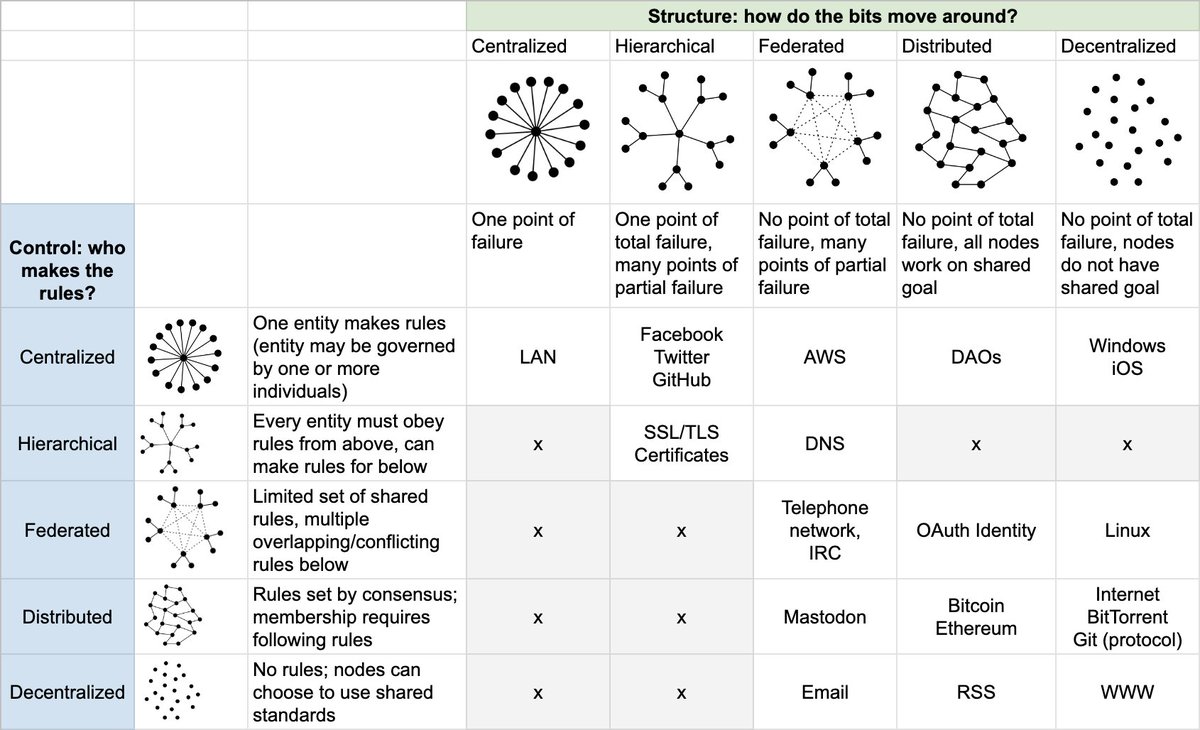
▶ 3 Promnesia | beepb00p beepb00p.xyz
Possibly like Holochain (which is distinct from the blockchain architecture). Blockchain only seems helpful if you need all of the following:
- a database
- immutability
- distributed data
- decentralized & totally trustless
- append only
- cryptographically secure assurance
Confer Brandon Enright's provocative talk "Blockchain is Bullshit" for an elaboration of these features. The first 10 or so minutes is mostly uninsightful trolling, so the link takes one to his argument about the key features of blockchain.
AFAICT, Holochain eases the feature of "decentralized", although Laurie Voss suggests that it's better to think of Bitcoin & Ethereum as "distributed" (in both the structure & control).
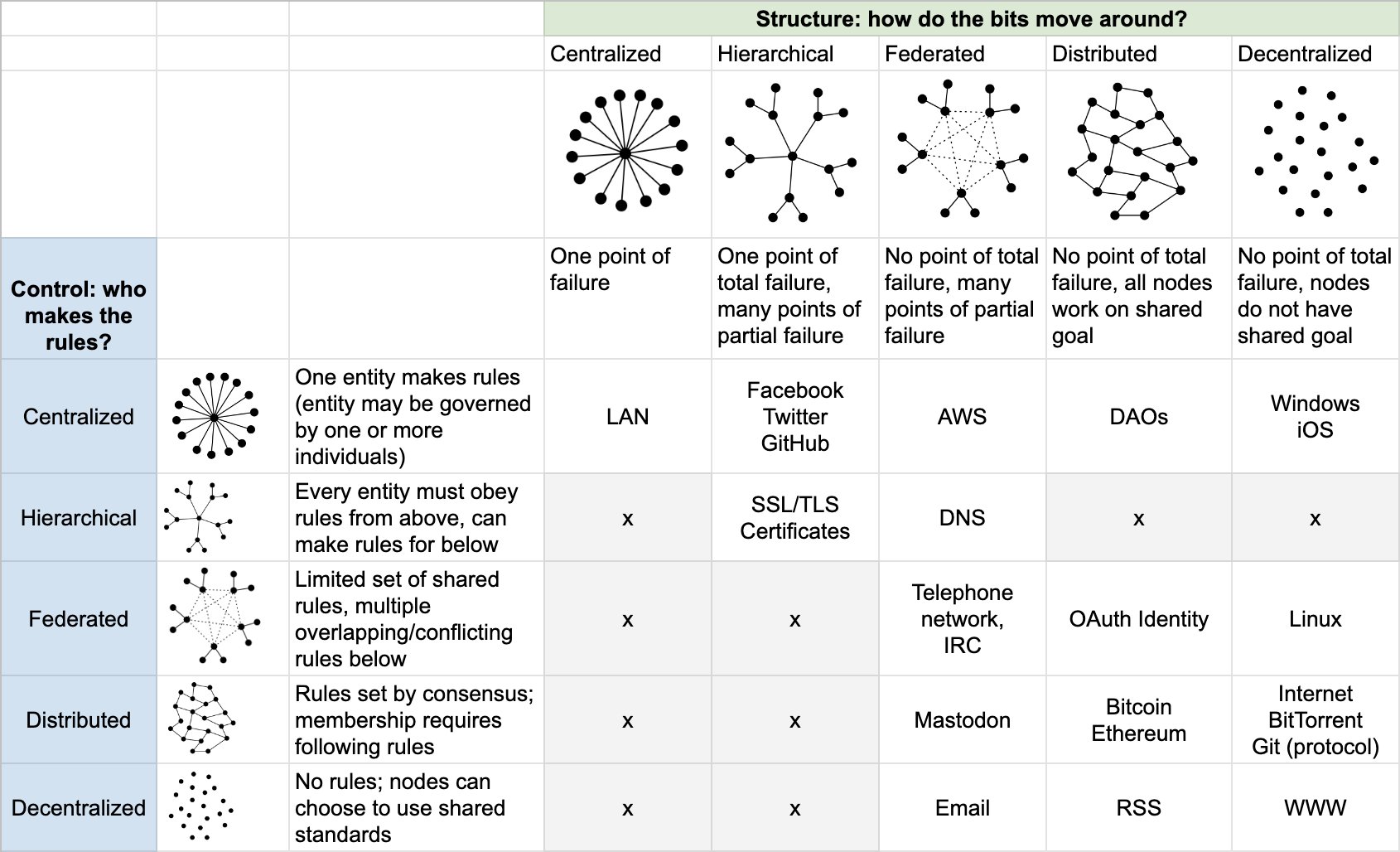
In Voss' taxonomy, I suspect that Holochain's structure would be "distributed" (ie, "No total point of failure, all nodes work on shared goal") and control would be "federated" (ie, "Limited set of shared rules, multiple overlapping/conflicting rules below")
This might be achievable through Holochain application framework. One promising project built on Holochain is Neighbourhoods. Their "Social-Sensemaker Architecture" across "neighbourhoods" is intriguing
Page recommended by @wfinck. Seems @karlicoss is the author. This project seems similar to what I've been trying to do with Hypothes.is, Obsidian, Anki, Zotero, and PowerToys Run but goes beyond the scope of my endeavors to just quickly access whatever resource comes to mind (without creating duplicates). The things that Promnesia adds beyond my PKM stack is the following:
- prioritize new info
- keeping track of which device things were read and how long
▶ 1 DEMO: How to setup and run your first Templater JS "script" · Discussion #187 · SilentVoid13/Templater github.com
▶ 1 Finite and Infinite Games by James Carse: Summary, Notes, and Lessons - Nat Eliason www.nateliason.com
A good summary of James Carse's book "Finite and Infinite Games"
▶ 1 Dynamic Commands - Templater silentvoid13.github.io
Page on the the Templater syntax <%+ ... %>. It allows use of "dynamic commands" which are only executed in preview mode in Obsidian
▶ 1 Prefix Zettelkasten creation date to file (YYYYMMDDHHmmss) · Discussion #623 · SilentVoid13/Templater github.com
Templater code snippet that renames current file to add date & time creation to title of note.
▶ 1 Discussions · Templates Showcase · SilentVoid13/Templater github.com
A set of examples of Templater use cases. Templater uses a JavaScript-esque syntax
▶ 1 weswalla/digital-garden: a public collection of my networked notes github.com
The GitHub repository for source code that generates the knowledge garden by @wfinck (which he calls a "digital garden"
▶ 1 maximevaillancourt/digital-garden-jekyll-template: Start your own digital garden using this Jekyll template 🌱 github.com
A template used by @wfinck to make this note in his public knowledge garden (ie, Zettelkasten notes with a displayed graph view of them)
▶ 1 How I use Anki to learn mathematics - LessWrong www.lesswrong.com
Example implementation of Anki into learning maths
▶ 1 Ep. 14 - Awakening from the Meaning Crisis - Epicureans, Cynics, and Stoics - Meaning Crisis Coalition www.meaningcrisis.co
John Vervaeke on Socrates becoming set of psychotechnologies to internalize and augment metacognition. Agues agumentation become central for Plato, whereas confrontation itself become central for Antisthenes. They're disagree about how the cause of the transformation through the Socratic approach
Unclear is stoics take up Plato's mantle of argumentation orientation, but they at least seem distinct from the Cynics (Antisthenes & teach Diogenes
Aporia is moment of shock from experience that you're radically transformed. Could be from Diogenes' provocative performance art or through discourse a la Plato & Socrates
Nietzche may have favored Cynics approach over stoic/Socratic. Possible parallel in left-hand path and right-hand path. Quick & risky vs. slow & steady
▶ 1 r/ObsidianMD - Is there a way to keep track of your daily word count in Obsidian/through plugins? www.reddit.com
Linux command for WSL to count all lines, words count, & character count. OP states at end -wc restricts to word count only
▶ 6 jcpp_1749 840..847 www.researchgate.net
Google Scholar is needed to access annotations in context "Listen to the noise: noise is beneficial for cognitive performance in ADHD"
Author's self-described "most intriguing result"
Known for who? General populations? Specific subpopulations?
Prediction of Moderate Brain Arousal model and author's additional argument.
Explains why studies on music at general population have conflicting results (ie, general decrease in capacity to focus with noisy environment). Wonder if this relates to atonal or discordant and dissonant music (free jazz, avant-guarde, etc) or polyrhythmic and odd metered time signatures
Model for explaining why the mechanism of stochastic resonance may be different for those with ADHD
▶ 2 Subspace topology - Wikipedia en.wikipedia.org
This definition can be used to demonstrate why the following function is continuous:
(f: [0,2\pi) \to S^1) where (f(\phi)= (\cos\phi, \sin\phi)) and (S^1) is the unit circle in the cartesian coordinate plane (\mathbb{R}^2).
Intuition
The preimage of open (in codomain) is open (in domain). Roughly, anything "close" in the codomain must have come from something "close" in the domain. Otherwise, stuff got split apart (think gaps, holes, jumps) on the way from our domain to our codomain.
Formalism
For some (f: X \to Y), for any open set (V \in \tauY), there exists some open set (U \in \tauX) so that it's image under (f) is (V). In math, (\forall V \in \tauY, \exists U \in \tauX \text{ s.t. } f(U) = V)
Demonstration
So for (f: [0,2\pi) \to S^1), we can see that ([0,2\pi)) is open under the subspace topology. Why? Let's start with a different example.
Claim 1: (U_S=[0,1) \cup (2,2\pi)) is open in (S = [0,2\pi))
We need to show that (US = S \cap UX) for some (UX \in \mathbb{R}). So we can take whatever open set that overlaps with our subspace to generate (US\text{.})
proof 1
Consider (UX = (-1,1) \cup (2, 2\pi)) and its intersection with (S = [0, 2\pi)). The overlap of (UX) with (S) is precisely (U_S). That is,
$ \begin{align} S \cap UX &= [0, 2\pi) \cap UX \ &= [0, 2\pi) \cap \bigl( (-1,1) \cup (2,2\pi) \bigr) \ &= \bigl( [0, 2\pi) \cap (-1,1) \bigr) \cup \bigl( [0,2\pi) \cap (2,2\pi)\bigr) \ &= [0, 1) \cup (2, 2\pi) \ &= U_S \end{align} $
Claim 2: (S= [0,2\pi)) is open in (\mathbb{R})
We need to show (S = S \cap UX) for some open set (UX \in \mathbb{R}\text{.})
proof 2
Let (UX = (-1,2\pi)) and consider the intersection of (S) and (UX\text{.}) It follows that $ \begin{align} S \cap UX &= [0,2\pi) \cap UX \ &= [0,2\pi) \cap (-1,2\pi) \ &= [0,2\pi) \ &= S
\end{align} $
▶ 1 networked note-taking and spaced-repetition software are scalable sense-making tools to help address the increasing knowledge complexity of the 21st century wesleyfinck.org
A beautiful example of a note that imbeds core zettels that simultaneously make connections within a Zettelkasten. Each page for a note displays the network of notes and their connections. The website is based on an open-source template
The source code for the site is here
▶ 1 Public good (economics) - Wikipedia en.wikipedia.org
Useful 2x2 matrix of
- private goods,
- common-pool resources,
- club goods,
- public goods
▶ 1 Functional Core, Imperative Shell www.destroyallsoftware.com
Video on Functional Core, Imperative Shell paradigm. Recommended in Hypothes.is testing documentation
▶ 1 When problems occur - Frequently Asked Questions faqs.ankiweb.net
Steps for trouble-shooting Anki issues
▶ 1 Brave Browser: how to modify extenions keyboard shortcuts superuser.com
Post about how to modify keyboard shortcut's for Brave browser extensions
▶ 1 SuperMemo Guru - supermemo.guru supermemo.guru
Page with many resources on
- Learning
- Creativity
- Intelligence
- Sleep
- Education
- Memory
- Health
- Productivity
- Myths
- SuperMemo
- Older texts
▶ 4 Testing — h 0.0.2 documentation h.readthedocs.io
Link to video on "Boundaries" doesn't go into depth on the functional core, imperative shell pattern. However, this one does: https://www.destroyallsoftware.com/screencasts/catalog/functional-core-imperative-shell
Keep functional & unit tests separate. Functional for common cases, unit for all others.
Probably means, "Call tox directly if you only want to run the backend test suite."
▶ 1 Diffbot | Knowledge Graph, AI Web Data Extraction and Crawling www.diffbot.com
CEO, Mike Tung was on Data science podcast. Seems to be solving problem that Google search doesn't; how seriously should you take the results that come up? What confidence do you have in their truth or falsity?
▶ 2 Annotating the law | Hypothes.is web.hypothes.is
Is there a way to search for your replies to someone's public annotations?
Currently, they don't show up when I search my user name and the tag I used in the reply. Is there an elegant way to search for these annotations and my reply to them?
I love that this exists. I have a couple questions!
- How does Hypothesis handle the fact that webpages can be edited, or webpages that aren't static? What happens to annotations when a page gets taken down?
- Is it possible to subscribe to specific users? For example, I might not want to see all public posts, only people who I follow. Or I might not want my posts to be public necessarily, but only to those who follow me. Or does this go against this tool's philosophy?
How does Hypothesis handle the fact that webpages can be edited, or webpages that aren't static?
I've actually seen this happen on a website that was annotated on a passage that got removed from that website's about webpage. What happened was that the person's annotation still existed, the highlighted passages was still visible on their annotation, but it had a strikethrough on the passage they highlighted.
I thought it was pretty cool that it still showed the passage even though it was removed from that page. Also, the annotation was still accessible on that page
▶ 2 Moment (mathematics) - Wikipedia, the free encyclopedia en.wikipedia.org
Vaguely recall these "uniquely determined" some (but not all) functions. Later on, the article says all moments from (0) to (\infty) do uniquely determine bounded functions. Guess you can't judge a book (or graph) by it's cover; you have to wait moment by moment for it to reveal itself
I should learn how to turn my Obsidian synced annotations into possible Zettelkasten notes. Look into using a an template, or embedded note, or occlusion
▶ 1 How I Track My Tasks in Obsidian medium.com
6 min read on tracking tasks with Obsidian. Might be helpful
▶ 1 Should You Use Obsidian for Task Management? – Curtis McHale curtismchale.ca
Examples include a separate Kanban board for
- camping tasks
- home-based tasks
- Obsidian management
- such as organize old files in database
▶ 1 Probability model vs statistical model vs stochastic model stats.stackexchange.com
Notation of a random process that has outcomes
The "universal set" aka "sample space" of all possible outcomes is sometimes denoted by (U), (S), or (\Omega): https://en.wikipedia.org/wiki/Sample_space
Probability theory & measure theory
From what I recall, the notation, (\Omega), was mainly used in higher-level grad courses on probability theory. ie, when trying to frame things in probability theory as a special case of measure theory things/ideas/processes. eg, a probability space, ((\cal{F}, \Omega, P)) where (\cal{F}) is a (\sigma\text{-field}) aka (\sigma\text{-algebra}) and (P) is a probability density function on any element of (\cal{F}) and (P(\Omega)=1.)
Somehow, the definition of a sigma-field captures the notion of what we want out of something that's measurable, but it's unclear to me why so let's see where writing through this takes me.
Working through why a sigma-algebra yields a coherent notion of measureable
A sigma-algebra (\cal{F}) on a set (\Omega) is defined somewhat close to the definition of a topology (\tau) on some space (X). They're both collections of sub-collections of the set/space of reference (ie, (\tau \sub 2^X) and (\cal{F} \sub 2^\Omega)). Also, they're both defined to contain their underlying set/space (ie, (X \in \tau) and (\Omega \in \cal{F})).
Additionally, they both contain the empty set but for (maybe) different reasons, definitionally. For a topology, it's simply defined to contain both the whole space and the empty set (ie, (X \in \tau) and (\empty \in \tau)). In a sigma-algebra's case, it's defined to be closed under complements, so since (\Omega \in \cal{F}) the complement must also be in (\cal{F})... but the complement of the universal set (\Omega) is the empty set, so (\empty \in \cal{F}).
I think this might be where the similarity ends, since a topology need not be closed under complements (but probably has a special property when it is, although I'm not sure what; oh wait, the complement of open is closed in topology, so it'd be clopen! Not sure what this would really entail though 🤷♀️). Moreover, a topology is closed under arbitrary unions (which includes uncountable), but a sigma-algebra is closed under countable unions. Hmm... Maybe this restriction to countable unions is what gives a coherent notion of being measurable? I suspect it also has to do with Banach-Tarski paradox. ie, cutting a sphere into 5 pieces and rearranging in a clever way so that you get 2 sphere's that each have the volume of the original sphere; I mean, WTF, if 1 sphere's volume equals the volume of 2 sphere's, then we're definitely not able to measure stuff any more.
And now I'm starting to vaguely recall that this what sigma-fields essentially outlaw/ban from being possible. It's also related to something important in measure theory called a Lebeque measure, although I'm not really sure what that is (something about doing a Riemann integral but picking the partition on the y-axis/codomain instead of on the x-axis/domain, maybe?)
And with that, I think I've got some intuition about how fundamental sigma-algebras are to letting us handle probability and uncertainty.
Back to probability theory
So then events like (E1) and (E2) that are elements of the set of sub-collections, (\cal{F}), of the possibility space (\Omega). Like, maybe (\Omega) is the set of all possible outcomes of rolling 2 dice, but (E1) could be a simple event (ie, just one outcome like rolling a 2) while (E2) could be a compound(?) event (ie, more than one, like rolling an even number). Notably, (E1) & (E2) are NOT elements of the sample space (\Omega); they're elements of the powerset of our possibility space (ie, the set of all possible subsets of (\Omega) denoted by (2^\Omega)). So maybe this explains why the "closed under complements" is needed; if you roll a 2, you should also be able to NOT roll a 2. And the property that a sigma-algebra must "contain the whole space" might be what's needed to give rise to a notion of a complete measure (conjecture about complete measures: everything in the measurable space can be assigned a value where that part of the measurable space does, in fact, represent some constitutive part of the whole).
But what about these "random events"?
Ah, so that's where random variables come into play (and probably why in probability theory they prefer to use (\Omega) for the sample space instead of (X) like a base space in topology). There's a function, that is, a mapping from outcomes of this "random event" (eg, a role of 2 dice) to a space in which we can associate (ie, assign) a sense of distance (ie, our sigma-algebra). What confuses me is that we see things like "(P(X=x))" which we interpret as "probability that our random variable, (X), ends up being some particular outcome (x)." But it's also said that (X) is a real-valued function, ie, takes some arbitrary elements (eg, events like rolling an even number) and assigns them a real number (ie, some (x \in \mathbb{R})).
Aha! I think I recall the missing link: the notation "(X=x)" is really a shorthand for "(X(\omega)=x)" where (\omega \in \cal{F}). But something that still feels unreconciled is that our probability metric, (P), is just taking some real value to another real value... So which one is our sigma-algebra, the inputs of (P) or the inputs of (X)? 🤔 Hmm... Well, I guess it has the be the set of elements that (X) is mapping into (\mathbb{R}) since (X\text{'s}) input is a small omega (\omega) (which is probably an element of big omega (\Omega) based on the conventions of small notation being elements of big notation), so (X\text{'s}) domain much be the sigma-algrebra?
Let's try to generate a plausible example of this in action... Maybe something with an inequality like "(X\ge 1)". Okay, yeah, how about (X) is a random variable for the random process of how long it takes a customer to get through a grocery line. So (X) is mapping the elements of our sigma-algebra (ie, what customers actually end up experiencing in the real world) into a subset of the reals, namely ([0,\infty)) because their time in line could be 0 minutes or infinite minutes (geesh, 😬 what a life that would be, huh?). Okay, so then I can ask a question like "What's the probability that (X) takes on a value greater than or equal to 1 minute?" which I think translates to "(P\left(X(\omega)\ge 1\right))" which is really attempting to model this whole "random event" of "What's gonna happen to a particular person on average?"
So this makes me wonder... Is this fact that (X) can model this "random event" (at all) what people mean when they say something is a stochastic model? That there's a probability distribution it generates which affords us some way of dealing with navigating the uncertainty of the "random event"? If so, then sigma-algebras seem to serve as a kind of gateway and/or foundation into specific cognitive practices (ie, learning to think & reason probabilistically) that affords us a way out of being overwhelmed by our anxiety or fear and can help us reclaim some agency and autonomy in situations with uncertainty.